Monday, May 18, 2020

Crinkly wrinkly shapes with Heptominoes

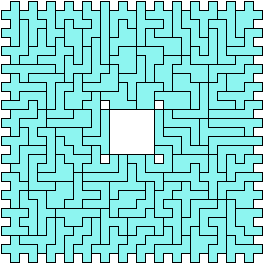
Seeing as I have an excess of spare time on my hands recently I've been attacking some constructions that I had previously written off as 'too hard' or at the very least on the boundary of what I could do without 'cheating' and using a computer solver. One of these is the following 29x29 rectangle with wrinkly crenelated edges around the outside, and a little 5x5 hole in the centre. And a couple of other little holes too because the harbour heptomino needs something to chow down on.


This wasn't the easiest thing in the world to put together. The first challenge was the outside corners. There are a very limited number of pieces that can occupy those corners, and I only discovered this a little way into the solution - too far in to just backtrack and start again, corners-first. Miraculously I hadn't used up too many of those precious corner pieces when I realised, so I was able to keep on trucking.
The whole perimeter of this was a completer pain in the arse to do. I started out with the left-hand edge, using pieces derived from the C- (or U- if you're weird) pentomino but they ran out fast and by the time I got to the final edge (the right-hand side) I was stuffing whatever pieces I could in, in the desperate hope they'd fit.

And they did. But they didn't leave a nice set of pieces remaining. And they didn't leave a nice shaped internal hole either. Still, I pressed on.

Fig. 2: Approximately what I had left to contend with after completing the perimeter.
From here I filled in the remainder of the space going around clockwise starting from about the 4 o' clock position. In fact, here's a needlessly detailed step-by-step of what I did. I usually refrain from this on the grounds that it's not very interesting, but really, is any of this very interesting?

Firstly, that question mark-shaped piece was just crying out to be put in that question mark-shaped hole, so I did that. Then there were a bunch of really hideous pieces (the other orange ones) that I just felt needed to be used up as early as possible, just so I didn't have to look at them again. Those two sort-of cross shaped bits especially. Winding up with one of those near the end of a solution when you're down to a handful of pieces is the stuff of nightmares.

Then, using up all those long S and L-shaped pieces because they're no fun either. Sadly, in order to do this we had to sacrifice that nice 2x4-with-a-notch-taken-out-of-it piece, but it was for the greater good. And now the edges of the hole in that top-right section are all relatively smooth and straight - ideal for for the very end game when you're solving with relatively squarish blocky pieces.

This is where the going started to get even tougher. Those two red pieces especially, I have a personal vendetta against now. I managed to get them all packed in there - but at what cost? So many potentially useful end-game bits used up in their prime.

Got that top-left corner squared off. And at this point we're left with not the worst hole in the world (that award would have to go to... I don't know, the ozone hole? Or the holes in the end of trombones that allows them to make their noise), but not the easiest to solve either. That two-cell-deep well at the far left was to haunt me for the next hour or so.
And the pieces I was left with to try and plug this hole? Check out this ragtag bunch of misfits:

Admittedly not the worst selection imaginable, but still... especially that one that kind of looks like a number 4 or a heavily-damaged tuning fork (kindly marked in orange for your identifying pleasure), that can suck a fat one. You'd think that piece and the 2-cell well would be a match made in heaven, but try as I might, it just was not to be...

At this stage in the game, there really is no more technique to speak of, no prioritisation of pieces or synergies between two pieces that are painful to deal with on their own but make a well-behaved 14-omino when coupled together. It's just a case of try something then if it fails tear it out and try something else. And that makes solution times vary wildly. Sometimes just through blind luck you'll stumble upon a valid solution after five minutes; other days it's hour after grueling hour trying various configurations in vain.  I guess the factor that determines how long this takes will be how many solutions to this particular endgame there are lurking in the search space as you wander randomly through it.

I got all but one piece in several times as I was doing this one. That's always the worst, that feeling of so near yet so far... And there's another weird thing that happens occasionally when finding a correct solution. It's when you get that 'eureka' moment, that "Yes! I've done it!" spark of excitement a fraction of a second before you've actually understood how the last two or three pieces are going to fit in there. I'd write it off as premature celebration if not for the fact it only ever seems to happen when I've got an actual solution on my hands - maybe I'm subconsciously spotting the solution and the rest of my mind takes that split-second to catch up? 'Tis a mystery.

Here's the eventual configuration I found. A quick consultation of some solving software tells me that there are 9 solutions to this, and that 5 of them do fit that '4'-shaped piece into the two-cell well, so goodness knows how I managed to miss 'em all.

In fact, here's all nine, since I'm being so generous with the pictures today. Mine is number 7.


And while we're on the subject of wicked tough constructions, here's another recent one that might be a contender for 'hardest construction so far', or at the very least most time-consuming:


As I've probably mentioned at some point before, octiamonds are just not a pleasant bunch of shapes to work with.
Sorry, no step-by-step account for this one. Partly because I solved this about two weeks ago so I can't remember the solution process clearly (other than that it was all over the place), and partly because I'd rather not re-live the experience. All I know is I solved the bottom edge first, and the rest followed, four hours later...

Friday, May 1, 2020

The cruel irony of all this is I'm awful at Tetris

I've been playing with a set of hexominoes a lot recently. It seems the bottom of the barrel wasn't as thoroughly scraped as I'd previously thought.
It turns out there are a family of shapes that approximate hexagons with angles of 90 and 135 degrees that are just as versatile as rectangles, if a little less pleasing to the eye (especially if you're not too fussy about them having a few holes in 'em.) These also have an added bonus: the diagonal edges make these a slightly more challenging solution than squares and rectangles.

Again, odd x odd bounding boxes seem to work best with this, because an even width or height would mean a line of symmetry bisecting the entire shape into two congruent 110-cell sub-shapes, which would mean the overall shape has balanced checkerboard parity. So with the aid of a hideous and confusing spreadsheet I knocked together, I found the following set of solvable problems:

3x73 - 9 holes
Yeah no. I think we can generally rule out the possibility of any purely 3xn constructions with hexominoes. I roughly outlined my reasoning here (but that's not a rigorous mathematical proof so it could well be wildly incorrect...)

5x54 - 3 holes
Pros: At this width solving these shapes feels not much different from solving a normal rectangle.
Cons: Solving a width 5 rectangle isn't exactly a walk in the park.


7x35 - 11 holes
At this point there's a sort of 'choose your own difficulty' option built in - with the difficulty levels being hard, harder and hardest, naturally. Two immediate options for arranging the 11 internal holes are having them as one big 11-omino, or as a line of 11 individual monominoes. The long 11-omino option creates two stretches of treacherous 3xn space which takes a bit of doing:


Whereas the individual holes introduce all manner of feisty challenges.


This one's left as an exercise for the reader. I spent a little while trying to solve it and got fairly close, but not close enough. I think I gave it like 45 minutes or so and wound up with like 6 pieces remaining a few times. But they were never nice pieces.

9x29 - 11 holes


This one was tough, although in hindsight this could be because of a complete lack of solving strategy. The obvious (looking back now) thing to do would have been to solve the ends first, then either the top half or the bottom half of the middle (if we think of the row of holes as a dividing line), trying to leave a fairly convex-looking endgame to be filled in last with the 2x2-block-y pieces. Instead I just went at it the way a nine-year old would his first all-you-can-eat buffet, and I paid for it dearly by spending maybe close to two hours (!) getting those last few bits in.
You know you've utterly stuffed it when you're down to the last five pieces and one of them is the stair-step hexomino (as it's known in Conway's Game of Life terminology).

11x25 - 5 holes
This is the start of the sweet spot, so to speak. Wide enough so that the central holes don't get in the way too much, but not so wide that there's miles of diagonal edge to contend with.


Of course, the fact that there's only 5 holes maybe makes this a little easier too. You could just as easily do this with the holes arranged vertically. Or with one bigger hole shaped like a pentomino of your choice.

13x23 - 5 holes


Can be done with the five holes the other way on. (So can the 11-height one but I didn't think of it at the time.)

I think there is a 15xn possible but it's going to have like 17 holes or something, and I think there's a point where unless you can arrange them in a particularly pleasing way it just gets silly. So I'll skip over this and go straight to...

17x21 - 3 holes and 19x21 - 9 holes
No solution images here, for the simple reason that I just plain can't be arsed. If you want them that badly, acquire a set of hexominoes and have a go at finding them yourself. More fun than looking at a picture of someone else's solution, guaranteed. Or feed them into a solver program, they'll eat these for breakfast.

And finally, 21x21 - 11 holes
This is just a rotated square at this point. And I've seen a solution for this on the internet somewhere, with the 11 holes as the straight 11-omino dead centre. As far as I can remember it was illustrating something to do with parity imbalance, and this was the example where the difference between black and white squares is exactly ±22, the maximum permissible. I assume that the restrictions that places on parity-imbalanced pieces means it's a head-bendingly difficult solution.

[EDIT: The solution I saw somewhere was here, on page 9 of Chessics, issue 28]


(The above solution was found using a computer search. Because it sounded like it might be difficult to do, and I'm always one to back down from a difficult challenge when one presents itself.)

Sunday, April 12, 2020

One Whole Year (of this nonsense)

...give or take a couple of days. April 4th 2019 was the first post on here so it's like a year and a week or so, but whatever, close enough. Honestly I'm surprised it's still going, when I first started out I had a suspicion I'd quickly run out of things to write about. And while I've long since ran out of interesting things to write about, that's a whole 'nother matter...

Having said that, there's potential for covering new ground yet. Since discovering the joy of custom laser cutting I've made various new sets of things, polytans, polyiamonds, I even made a physical set of those 3½-ominoes I posted about a while back, replacing my original set that I'd cut out of the card from a box of cereal bars.

Anyway, for old times' sake, here's another heptomino construction. When I first started this blog one of my little ground rules was to include an image with every post, because when I was a teenager and first getting into polyominoes in a big way I gravitated to the sites like Andrew Clarke's Poly Pages with heaps of pictures all over them. Except I never understood why nearly every site seemed to use that greeny brown colour for all the illustrations. The international standard colour scheme for polyforms, I guess.
Fig. 1: The heptominoes in a long skinny hexagon with a single central hole.

Tuesday, March 31, 2020

Concentric Rectangles

I'd like to blame the fact I'm stuck indoors avoiding the Coronavirus for this one, but realistically I'd have probably found the time to solve this anyway, given that I lead such an exciting life:


It's an awful photo, but here's the gist of it. Imagine a 7x9 pentomino rectangle (with a little 3-cell hole) inside a 13x21 hexomino rectangle, inside a heptomino rectangle I can't remember the dimensions of and can't be arsed to count, all surrounded by the octominoes (plus 8 holes) in a whopping 47x85 rectangle. And that's what I spent an entire afternoon doing. Well, two sittings with a break for dinner in the middle.

It would maybe have been a bit nicer if I'd started with a central monomino and worked my way up through all polyomino sizes, a la Karl Wilk's Polyominium, but there didn't seem to be a way of doing it that yielded such nice symmetrical layers like this. It's difficult to wrap a pentomino rectangle around a hole big enough for just the tetrominoes, let alone anything else.
In fact, when I had the original idea that became this, it was born out of the fact I'd built a hexomino pattern that just happened to be able to fit the 7x9 rectangle inside.

A sort of precursor solution found way back.
Peeps with a keen eye will have spotted that the pent-, hex- and heptomino sections of that early solution are totally different to the ones this time round - more a testament to how bored I was than anything else.

Fun fact about the 7x9 pentomino solution: when the triomino hole is vertical there are 360 possible solutions, whereas with the horizontal hole there are a mere 150 (excluding rotations, reflections and all that jazz.)

Here's the full solution drawn up so you can actually see where one piece ends and another begins:

And there's a little voice inside me saying "What about a layer of nonominoes?" but realistically I'm not going to be able to do that without a physical set of them and that ain't gonna be cheap. Besides, there's not a flat surface in my house big enough to hold all those pieces.

Friday, March 27, 2020

Octiamonds

Polyiamonds are tricky. Even the smaller sets seem harder than their similarly-sized polyomino counterparts. Hexiamonds, for example. There's 12 of them, same as the pentominoes, and in a geometric sense they don't seem any more jagged or otherwise unruly, but for whatever reason solving anything with them seems a lot harder.
I mean, it could just be that I'm more used to polyominoes and that a sort of intuition for other polyforms would build naturally with time. And with polyominoes I know all the handy tips and tricks, which pieces (or types of pieces) are most useful in which situations, whereas with polyiamonds I don't have that (yet).
With larger sets of polyominoes, (i.e. hexominoes and above) a technique emerges of saving the more cooperative shapes for the end game, and as the sets get larger this pool of 'nice' pieces increases rapidly in size. But with (say) octiamonds it's not so obvious which shapes are the most useful. They're all pretty hideous, actually, at least to the untrained eye. The little hexagon made of six triangles is the closest analogue I can think of to the 2x2 square block that makes for nicely-behaved polyominoes. But there are only 4 out of 66 octiamonds which contain it and even these 4 pieces don't play especially nicely together with each other.

So the solution below was the result of about an hour and a half of stumbling about cluelessly followed by a flash of pure luck.
Fig. 1: The 66 octiamonds in a 12x22 parallelogram.
 Another fun fact: Drawing these out neatly is really hard too. Pixel art and triangles don't mix too well.

Thursday, March 5, 2020

Finally! Truncated 55x55 Square with Octominoes


Third time lucky, eh?
Getting that central 13-hole configuration to work was surprisingly tricky - they're too close together to just treat as individual holes, sling a holey octomino around some of them and be done with it.*

Then throughout the rest of the solve I had in the back of my mind a little nagging concern that maybe some issue like parity would render this solution impossible anyway. The octominoes as a full set have no glaring issues the way the tetrominoes and hexominoes do, but the 363 non-holey ones are imbalanced when checkerboard-coloured. And since I'd used the 6 holey pieces first I was in effect left with this imbalanced set. I assumed (well, hoped) that since the construction's dimensions were odd x odd this might negate the issue; I use this as a rule of thumb for hexomino constructions because it usually means that the overall structure is sufficiently unbalanced and therefore solvable.
Whether this makes any sense mathematically I have no idea.

Total solve time was approximately 5 hours spread over a few days. Total time drawing up the digitised image of the solution probably took another hour on top of that, come to think of it.

---

* This construction by David Bird does something similar, there's probably only a handful of ways of accommodating those holes in that shape.

Monday, February 24, 2020

placeholder title

After playing with octominoes for a bit, returning to the trusty ol' heptomino set is a strange feeling indeed. All the pieces are so tiny and simple in comparison, and suddenly 108 feels like such a reasonable, manageable number.
I made this, which has the maximum possible symmetry for a heptomino pattern.

Fig. 1: 28x28 with 28 holes.
This was a surprisingly painless solve too (although anything would feel that way after octominoes) - the last pieces all fitted into place on practically the first attempt and the whole solve couldn't have taken much more than half an hour. (And now there's an awful idea: speed-solving polyominoes!)

And here's some assorted hexomino things from 2019 that never made it onto the site because they weren't particularly challenging or interesting.

But these are the lengths you gotta go to when you've been too busy recently to do any interesting polyomino stuff but don't want to completely abandon the blog.