Showing posts with label heptominoes. Show all posts

Saturday, September 16, 2023

Miscellaneous Solutions That Didn't Deserve Their Own Posts, Volume 2

First here's an interesting coincidence. The total areas covered by the hexominoes and heptominoes are 210 and 756 respectively. In both cases these numbers can be written in the form n² − n where n is a triangular number (15 and 28). This can be illustrated as in the image below:


Sadly the areas of the other polyomino sets don't continue the pattern - the trominoes get closest: they have area 6 = 3² − 3 with 3 a triangular number, but a 3x3 square isn't big enough to hold three internal holes.

Secondly here's a construction with the heptominoes that I did a few days ago as a means of easing myself back into the whole solving lark. Like all skills it works like a muscle, don't use it for a few months and it's really difficult when you get back into it.

Solved top rectangle to bottom, right to left for the first one then left to right for the second and third. And I relearnt the importance of piece ordering, i.e. using the really difficult pieces up as soon as you possibly can. Because I'd accidentally held onto the 'F' and square bracket shaped pieces in the bottom right for way too long, and they made finishing that last corner really really difficult.

Finally, here's another heptomino thing. The idea/design was a challenge posed by Livio Zucca on the Puzzle Fun Facebook group, and the solve was not easy. So not easy, in fact, that I had to resort to FlayPoly2 to place the last 10 or so pieces. The four little green rectangles took up a lot of nice corner pieces for a start, and then those four 3xn limbs on the blue and yellow sections that reach towards the centre were massively restrictive too in terms of which pieces would actually fit there.

So if you already read the Puzzle Fun group religiously then 2/3 of this blog post will have been old news by now. And the other 1/3 isn't particularly interesting news either.

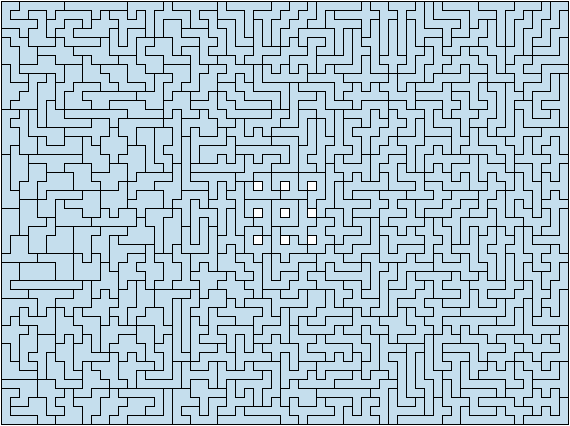
Oh, and here's an octomino rectangle that I solved about a year ago then never bothered to post anywhere as far as I know. Forty-seven by sixty-three.


EDIT: And this one too. This one has a 28x28 internal void that fits the heptominoes. It could even fit that 28x28 with the holes arranged all triangular from the very top of this post if you switched it out. But here it's got a heptomino pattern where the diagonal lines of holes sort of kind of line up with four of the holes in the octominoes.
Again, both heptomino and octomino sections all done entirely by hand (well, using a set of plastic octominoes, which is a little bit easier than pure pen and paper but still takes some doing).


For all the effort it takes to digitise these solutions, I have no idea why I just sort of let them fester on a folder called 'Polyominoes' on my desktop and don't do anything with them. Until the time comes when I notice it's been ages since I've put anything up on the blog or website, and I hastily chuck together a post like this one with them all in.

Monday, January 2, 2023

Planar Heptacubes the Lazy Way

Usually polycube constructions are beyond my capability, since I don't own any physical sets beyond the tetracubes and have a computer that would probably struggle to find things with sets much larger than pentacubes. (I think hexacubes have a checkerboard parity issue just like the hexominoes as well, which makes the prospect all the more terrifying.) But recently I realised something about the set of thee 108 planar heptacubes that could make a few solutions possible despite only owning a set of bog-standard heptominoes.

Of the planar heptacubes the only one that really needs any special attention is the harbour heptomino equivalent. Unlike the case with regular heptominoes it doesn't force a hole in the construction, but it does sort of require that it must be placed perpendicular to whichever heptacube is filling its hole. At some point a few days ago I realised that if the harbour heptacube (it feels weird calling it that somehow) was 'neutralised' by a small number of pieces then I could solve the rest of the heptacube construction purely in layers using my existing set of heptominoes. Saving me from having to cut up and glue 108 pieces. Which I'll do eventually, just not now. The tetracubes were already pushing the limits of what I can make.

It turns out that two other heptacubes are enough to make a little bullet-heptomino-prism that can be slipped into the corner of a 3x14x18 cuboid, leaving three layers with a multiple of 7 cubes that can be solved manually. Something similar is probably possible for a 6-layer cuboid, 6x9x14 maybe.

Or a 4x9x21... And solving into four rectangles is a lot less painful than solving six... Anyway, here it is:

As usual, dots indicate that a piece extends down into the layer below, and a little square means it extends up into the later above. In this case the three heptacubes that lie perpendicular to the plane so to speak are the analogues of the pi and harbour heptomino and the one that looks like a little H inside a 3x3 box.

Here's a view of it as a nice isometric image, a needless victory lap purely because I learnt how to use Inkscape recently and want to show off:

If I can ever manage to solve anything with the larger polyiamond sets, at least it'll guarantee that the images on that blog post will look better than the old ones do.

EDIT sort of: A few hours after writing this, the urge to solve the 4x9x21 became too difficult to resist, and after about an hour or so I had the following solution using the exact same trick as the 3x14x18 for dealing with the harbour piece:

If I ever do make a set of these pieces, a box that holds them in a formation like this would be really nice probably. EDIT: Just after I first posted this post I got a comment pointing out something I should really have spotted sooner - the 'H' heptomino in these constructions goes through the central hole of the harbour heptomino, so unless the pieces were made of something really flexible (like rubber or very soft foam or something) there's no way you'd actually be able to assemble any of these physically.

Wednesday, August 3, 2022

Picking this back up after a long break

Man, I've missed this so much. Only one post so far this year and it was ages ago. Basically, stuff just got kind of busy, a surprise change of job in February/March took up a big chunk of my time, and with my attention divided between the blog and the shiny new website I ended up not contributing a great deal to either. But~! Enough excuses. A few nights ago - just for the hell of it, just for old times' sake - I dug out the heptominoes and just had a crack at solving something with them. Just a 29x29 rectangle with a central 9x9 hole (and some other unit holes). Knowing full well it wouldn't be something interesting enough to write to the blog or the site about.

And I remembered why I started doing this in the first place.

Spring 2019 - when this blog started) - was, for me, not exactly the most fun of times. And I think in those evenings of stumbling into the world of polyforms, retreading the steps people like David Bird and Michael Keller had made way before me, it became a sort of meditative thing. When I was knee deep in a hexomino or heptomino thing all I was able to focus on were the pieces at hand (and occasionally the Andrew W.K. I had blasting on the iPod) and it was a welcome break from everything else going on. Kept me sane (or at least, kept me from getting any less sane than I already was...)

And I think that's what I need now.

Fig. 1: I finally made good on that promise to buy a proper camera instead of just using the one on my phone. Problem now is, I don't know how to use it (and I scale down the photos for the site anyway to save space) so they still look just as bad.

It's not like I've got a lack of things to write about on the blog, anyway. In the past 6 months or so I've been getting things made (generally laser cut) like no-one's business, though these generally lie in the more 'out there' realms of polyforms - sets where the base shape is something weird like a domino sliced in half diagonally, or assembly puzzles of mathematically incomplete polycube sets. Think Soma cube, and its many variations and relatives. Enough to keep churning posts out on here anyhow.

Here's a picture of some actual polyominoes, as way of apology for turning this place into LiveJournal up there before:

Fig. 2: Four-colouring these adds an interesting challenge.

Oh, and I made this too.

Add caption

It's the nine enneominoes that have either the 2x4 octomino or the 3x3 with a missing corner as a subset. There's one solution (excluding rotations and reflections) for getting them into that 9x9 box, and I'll leave it as a puzzle for the reader (if indeed there are any).

I made this stupidly small - the pieces are at a scale of 5mm/edge meaning the entire thing including tray is a mere 65mm wide. I was trialling how small I could feasibly make pieces and have them still be nice to play with. Because I have plans for a certain large set of pieces. And evidently 5mm/edge is just a tad too small. Might have to do 8mm.

Friday, December 24, 2021

Merry Christmas! (feat. some heptominoes)

This is the problem since getting the new website set up: Every time I have something I want to post I'm unsure of whether to do it here or put it there. And in the indecision I end up doing neither. So the blog looks abandoned and the site doesn't get updated. You'd think after like what, eight months, I'd have figured out a strategy for doing both, like updating here first then working the new stuff into the web page at a later date, but nope. I'll have to add that to the ever-growing list of New Year's Resolutions.

I'm still solving things with the heptominoes and such like. (And still sobbing into large sets of polyiamonds 'cause the pieces just won't go...) But there's just not so much happening that I feel the need to tell the world about. Some day there will be - some day there'll be a little momentarily lapse in judgement and I'll find myself ordering a set of enneominoes so big they'd practically tile the entire floorspace of my flat - but until then it's just making similar shapes with the same sets of pieces and there's nothing to say about that which the past fifty blog posts haven't already said.

So for now, have this square ring with the internal holes not quite evenly spaced. They're spaced enough so that it looks pretty at first glance, but then you realise the spacings are 5-6-5 and once you notice that it'll just irk you for ever more.

And now it's telling me 'spacings' isn't a word. Lovely.

Thursday, May 6, 2021

One Sided Heptominoes (and a new website!)

If you happen to own two compatible sets of heptominoes, then by discarding the duplicate mirror-symmetric pieces and turning a bunch of the remaining bits over so you've got distinct mirror image pairs, you have yourself a set of the one-sided heptominoes. Difficulty-wise they seem to slot in somewhere between heptominoes and octominoes - the main challenge now being resisting the urge to flip over pieces. The total area they cover is 7x196 = 1372 but as one of the pieces has a hole an extra unit cell must be accounted for when deciding on shapes to fill. (I suppose you could just discard the holey heptomino and see what you can do with an area of 1365. Maybe a 37x37 with 4 corner squares removed?)

Anyway, I found this 32x43 rectangle, just since it was my first time doing anything with the one-sided heptominoes and I didn't want to take on anything too elaborate straight out of the gate. The first two-thirds of the solution process feel pretty much the same as solving with the standard turn-over-able heptominoes, but when you get right down to the last few bits there are a lot more near misses - times where the remaining hole could be filled with the mirror images of the remaining pieces but not the pieces I was holding.

Fig. 1: A rectangle with the one-sided heptominoes. As far as I know there are no pieces which have been accidentally turned over, but I can't say for definite and I can't be bothered to check either.

In other news, I now have a website over at polyominoes.co.uk. Right now it's a complete mess and still very much under construction, but eventually it will have a lot of the information from this blog on it, just tidied up and organised in a slightly more logical way. Posts sorted chronologically make sense for some things but it also makes looking for specific things a complete nightmare, even when I manage to remember to tag them correctly.

Wednesday, April 14, 2021

More Wiggly-edged Rectangles

There's not a technical term for shapes like this, is there?

Fig. 1: With heptominoes.

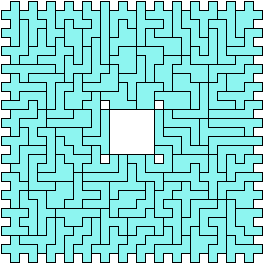
Those toothed edges are just as difficult as they look. They start out easy enough - the bottom edge was done first using pieces that it makes sense to put there, the 'H' shape and various other U-pentomino-derived pieces that fit perfectly. But alas there aren't enough of those shapes to go all the way around. And by the time I got to the middle of the top edge desperation had kicked in and I was using any piece I could to try and complete the perimeter. The straight line heptomino for example. And even one or two of the pieces with a 2x2 block which I generally try to hold onto until near the end.

Once the perimeter is done it doesn't get any easier. See, now I'm left with a very irregular cavity to fill, and if we want the central hole to be, well, central that forces the position of the harbour heptomino too. So you're left to squeeze an already awkward batch of pieces into a shape that really wasn't designed to accomodate them, just like last time.

- - -

As I was solving the above I wondered whether this sort of shape would be any easier with octominoes. On paper it felt like it should be - sure, an octomino rectangle would have a longer perimeter but the amount of pieces which would fit nicely into that perimeter would increase too. And the ratio of perimeter to area ought to mean that once the perimeter was completed we'd still have a large variety of pieces for the middle.

Fig. 2: The octominoes. Yeah, the corners are a slightly different style - I'd miscounted the number of teeth needed and offsetting them by one like this was a lucky save.

Turns out it isn't really that much easier after all. Maybe a tiiiny bit easier because of pieces like that 'E' shape in the top edge, but the perimeter got way longer and the number of nice pieces just hadn't increased enough to counterbalance it. Admittedly once I'd cleared that first hurdle, completing the rest of the solution was no worse than any other octomino solve I'd done in the past, so maybe I was partially right. Total time, maybe about 4 hours or so, spread out over one afternoon and evening. I don't know, I don't time these things. I just occasionally glance at the clock and realise I've wasted a whole afternoon and I should have had dinner an hour ago. But hey, there are worse ways to waste time.

Saturday, March 20, 2021

Some Assorted Solutions

Polyform-related shenanigans have been on the back burner somewhat recently, mainly because I'm in the process of moving house and don't have table space right now to spread out even a full set of hexominoes, let alone a larger set. So this post is going to be a collection of solutions I found several weeks ago but didn't write about at the time for whatever reason.

First up, continuing with the last post's theme of long skinny rectangles we've got the heptominoes in a 9x85 rectangle with nine holes. I think I found this with the intention of including it in that post, but then I found the 5 high rectangle which was way more interesting and in the interest of not making that post a mile long I took this one out.

In February some time I put together another variant of the well-known side 20 diamond found originally by David Bird - same outer shape, different hole configuration. Nothing particularly groundbreaking to look at, but the solving process was interesting. The jagged outer edges use up pretty much every piece with any stairstep-type edges, leaving a glut of pieces with 2-cell protrusions for the middle. Which is less than ideal.

And finally, I found a few more fun things with the hexominoes, in what I call the 15x15-15 challenge because I'm terrible with names like that. The idea is, make a 15x15 square with 15 holes using the hexominoes. The challenge is to make the 15 holes look nice, given that they can't retain the symmetry of the outer square. There's some examples here (from back in 2019) and a few more just below, from back in March.

A silicon ship looking configuration.

Side note: For whatever reason the word 'quincunx' makes me giggle like an idiot.

Oh yeah. One last thing that I almost didn't include since it's a shameful chapter indeed in the history of polyominoes. I had attempted a heptomino construction with the crenelated edges similar to that top hexomino one. And I made the classic mistake of doing the math for it late one night when I was too tired to be trusted with simple tasks like adding a few numbers up. This was the result:

Yep. For whatever reason I'd thought that each edge had one more protrusion than it did which threw my area calculation off by 4. And because it was late and I was just itching to get my solve on, I didn't even think to double-check everything. I just never learn...

Sunday, March 7, 2021

Polyominoes: How Thin Can We Go?

What is the narrowest rectangle (or vaguely rectangular shape) that can be constructed with each set of polyominoes?

Lets get the easy cases out of the way first. For pentominoes, there are 4 possible rectangles that can be made, the narrowest of which is 3x20:

Fig. 1: One of two ways of doing this (excluding rotations and reflections).
See if you can find the other way. Go on. I double dare you.

The tetrominoes don't do any rectangles due to parity issues, but if you add the triominoes (and optionally domino) into the mix you get a set that can fit nicely within a 2xn rectangle:

Fig. 2: Apparently there are 84 solutions to this excluding rotations and reflections.

 For hexominoes, each individual piece can fit within a 3xn space but we are able to rule 3xn rectangles out for the entire set together - see this older post for the grisly deets. 4xn however is totally possible as illustrated below:

That's all well and good, but what about heptominoes?

An obvious starting place is the well-known 7x10⁷ rectangle which can be made in a variety of ways using the 107 non-holey heptominoes. There's one a little way down this really old post which I found, but I was hardly the first to do so. A few weeks ago I went one better, building the following 6x127 which ended up being the inspiration for this blog post:

(Click for full size)

Thin rectangles are a fair bit harder to solve (manually at least) than wider, more squarish rectangles of the same area. I'm guessing it's just to do with the higher perimeter-to-area ratio. Every extra square bordered by perimeter is a further restriction on the heptominoes within the shape (as are things like holes). And once you get thin enough it begins to restrict weird things, like the orientation of polyominoes within the shape. A heptomino that spans 6 cells in one direction will touch both the top and the bottom side of the 6x127 rectangle for example, and if placing that shape partitions the rectangle into two areas whose areas aren't a multiple of 7 then you've just rendered the lot unsolvable.

A 5 square high rectangle with a mixture of the 1- through 7-ominoes is possible, as demonstrated in the picture below, solver unknown.

I don't know where I got this image from or who to credit for the solution. If anyone knows anything about its mysterious origins please stick it in a comment below.

Here's a neater version with the polyominoes coloured by size:

(Click to embiggen)
 

I also found the following 5x152 pure heptominoes solution using Aad van de Wetering's FlatPoly2 software.

Click for larger. It was either this or insert it vertically and make this post a mile-long scrolling marathon.

The first three quarters or so were placed by hand, and then the final 26 were input into the solver. For whatever reason (I think it's just my computer) the software takes aaages to find anything if you just give it the full shape and all the heptominoes - in fact I've never actually been patient enough to let it finish - so the only way I can find solutions is to solve manually until there's about 20 (or fewer) pieces then let it solve from there.

And height 5 might be the best we can do.

In a similar way to what we did for hexominoes, we can rule out shapes of width 3 and lower - there's a V-shaped heptomino that reaches out 4 squares in two directions, which isn't going to fit no matter how you place it. And for 4xn we run into issues too. According to the analysis that Peter Esser's 'mops' solver does, the set of heptominoes can cover a total of 373 border squares. And a 4 unit high rectangle has to be at least 190 units long for the area to be >756 (allowing for holes for the harbour heptomino.) This means we have 380 border squares for the two long edges alone (and a few more for the little short edges) which the heptominoes just can't manage. So 5 might just be as thin as we can go.

Saturday, January 9, 2021

2021! (a.k.a. A Fun Little Challenge with Heptominoes and Hexominoes)

Happy new year! Going to kick off 2021 with a lazy low effort post.

In an older post I found two hexomino rectangles which had twelve holes, each in the shape of a different pentomino. Or it could be thought of as a combined pentomino/hexomino rectangle with the added condition that none of the pentominoes touch each other or the edge of the rectangle.

The topic was brought up on the 'Puzzle Fun' Facebook group, and the gauntlet was thrown down - was the same thing possible for heptominoes with hexomino-shaped holes? I had a go and found the following:

Fig. 1: 22x44. Separating the hexominoes and heptominoes out when dismantling the finished construction was not a fun job.

There's two monomino holes in there, one has to be there to placate the harbour heptomino, the second is there because otherwise the combined area (7*108 + 6*35 + 1 = 967) would be a prime number. And the hexominoes are at a higher concentration in the bottom half of the rectangle. I wasn't sure how much space I had when I started off constructing this so I packed them in really tightly at first, then when I got about three-quarters of the way through I realised I had like 4 hexominoes left so they're a tad sparser up there.

the inevitable next step will be the octomino/heptomino equivalent of this. I'm putting off starting it but I'd give it a month tops before I cave and begin trying to solve it.

Sunday, December 6, 2020

Squares

This has bound to have been done before, it seems too obvious a thing not to. But rediscovery or not I'm going to write about it at length anyway and nobody can stop me.

Imagine this: squares, right, but made out of polyominoes. Gripping stuff, eh?

Pentominoes

With tetrominoes and below you can't really do a lot, for all the usual reasons. Tetrominoes have got parity imbalance, triominoes and dominoes are just tiny sets you can't do a lot with, and while I suppose you can make a 1x1 square out of the set of monominoes (all one of them) it's not the most interesting thing in the world so we'll jump ahead to where it starts to get interesting.

One set of pentominoes can pack a 5x5 square and a 6x6 square simultaneously, if you don't mind an off-centre hole in the 6x6 to bring its total area down to 35. Shown above is one way of doing this, but there are at least 2 more, not counting rotations and reflections as distinct solution. Sadly there is no combination of squares without holes that the pentominoes can fill, just because 60 can't be partitioned into square numbers divisible by 5.

Hexominoes

This lot are frustrating due to the usual parity constraints but nevertheless we'll give it a go. Square sizes permitted are 6² = 36 and 12² = 144 for solid squares, and 5² = 24+1, 7² = 48+1, 11² = 120+1, 13² = 168+1 if you want to allow a square with one solitary central hole. Which feels like bending the rules but alleviates parity issues somewhat, and will be needed for heptominoes and above where we've got pieces with holes whether we like it or not.

Making 210 with a combination of the above squares is our next problem. Each of the above squares would contain an even number of hexominoes, meaning that no combination of them would ever contain exactly 35 hexominoes. Damn.

One avenue to explore is to allow duplication of one of the hexominoes, bringing the set size up to 36 and total area to 216. This can be broken into squares, the most obvious partition being six 6x6 squares. This is... difficult. I've tried it by hand, I've tried running various software to find a solution, no luck so far. All I know is that for this to work the duplicated hexomino must be one of the ones with 2-4 parity imbalance. And that it's possible to solve six 6x6s for the set of hexominoes plus triominoes. So if solutions do exist, they look to be pretty few and far between.

But there are other ways of making 216 from the above numbers. 6² + 6² + 12² works, as does 7² + 13² with a central hole in each. The duplicated hexomino in each case is shown in a different colour (again, the duplicate must be one of the 11 pieces with unbalanced parity.)

6² + 6² + 12² = 216


7² + 13² = 216 + 2

As a general rule, the more squares and the smaller the squares are, the harder it is to find a solution.

5² + 5² + 7² + 11² = 216 + 4

Another fun challenge would be to place the two duplicate pieces in a symmetrical or otherwise aesthetically pleasing way. I've just been letting pure chance dictate which piece is duplicated and where it ends up, i.e. solving the 35 unique pieces and hoping the 6 remaining squares are all joined together. It works but the solutions aren't always the prettiest.

Heptominoes

This is where it starts getting fun. For the first time we've got a real choice of how many squares we can do and what size they are. For unholey squares the sizes possible are 7², 14² and 21² (28² > 757 so we don't need to worry about that) and for squares with a centre hole (which we're gonna need for the harbour heptomino) the available sizes are 13² and 15². Actually, a 6² or 8² would be possible but the hole would be off-centre so I didn't consider these. We can afford to be picky here.)

I didn't do an exhaustive list of what was possible, I just found a bunch of squares whose area added up to 756 and jumped right in. The first solution I found was the picture below.

Three 7x7s, a 13x13 and 21x21 with heptominoes.

I did the little squares first because they're the most restrictive in terms of which pieces can be used then did the great big square at the very end. I then realised that instead of having a 21x21 square, I could create four 7x7s, two 14x14s and a 13x13 which would yield a little more challenging of a solve.


'A little more challenging' is putting it lightly.

For a start, it took me two attempts. Admittedly this was down to my own stupidity - on the first attempt I'd done the four small squares first then moved onto the larger three, only to discover near the end that one of my 7x7 squares was actually a 6x7 and I had one leftover piece too many. The second attempt (the one pictured above) just took ages to do. Same solve order, but when I got to the last square (the bottom right 14x14) I was left with some really difficult uncooperative pieces and completing it took probably about six hours spread out over the space of the weekend.

The obvious next step here is this: One 14x14 is equivalent to four 7x7s. So It should be possible to solve a full set of heptominoes into the following:

  • Eight 7x7s, a 13x13 and a 14x14.
  • Twelve 7x7s and a 13x13.

Whether either of these is possible (or feasible solving by hand) is another matter entirely. I noticed with the construction with four 7x7s I was running out of pieces that would fit comfortably in corners or along edges by the end of the last square, and introducing even more edge is only going to make that worse. I might tackle those other possibilities at some point soon. But that's a pretty big 'might'.

Sunday, November 29, 2020

Little stopgap post while I think of something decent to write about

It's been a little while since I last posted anything on here. Here's a nice 4-way symmetrical heptomino construction, does that make it better?

Fig. 1: Those corners are surprisingly restricting of which heptominoes can make them.


In the past I used to crack open the box of polyform stuff in evenings as a way of relaxing and calming down, but recently I stumbled upon this monstrosity which seems to have the opposite effect on me:

Fig. 2: Eww gross.

Called the 'sawblade' in my little notebook where I sketch out possible constructable shapes, and although its just a pure hexomino puzzle it's way harder than it has any right to be. I found the above sort of near-miss early on, which fit all the pieces but had an asymmetrical clump for a central hole which just looks wrong. I mean, even the 'proper' solution has a 2-fold symmetrical hole in the middle of an otherwise 4-fold construction so it's never going to be perfect, but this was just too imperfect to live with.

Fig. 3: Better (marginally...)

It took a further three days of trying on and off, just whenever I had half an hour or so spare until I finally stumbled on a solution that had the central hole looking some way presentable. The real nightmare pieces in solving this were the long straight bits, the I-hexomino and the various pieces with a 5xn bounding box. And the big L-shape piece. Usually these can be sat against the flat walls of rectangular constructions but not in this case... Learning to use these up early on seemed to be the key to cracking this one.

I'm toying with the idea of laser-cutting a fresh new set of hexominoes (again...) this time using transparent acrylic so I can see the boundaries between pieces. It's tempting to make a tray for them shaped like the above pattern, especially since it's approximately square so the entire tray would be relatively compact. I could maybe have the central heptomino 'hole' in a contrasting colour too. The only drawback of all this would be that every time I wanted to tidy the pieces away into the tray I'd have to go through the ordeal of solving it.


 29th? Yesss! didn't miss a month!

Tuesday, July 28, 2020

A Few Parallelograms with Heptominoes

Edges with gradient 1:2 are surprisingly forgiving. When I started building this I had no idea just how long and skinny the resulting construction would be; I kind of pictured it in my head looking like the 45-degree parallelogram in this truly ancient blog post until I started building and it sprawled right out across the table.

Fig. 1: A 23x33 parallelogram
 
It turns out that the gentler slope here permits a much wider variety of pieces so it was easier than I'd anticipated. Solve order was like this: Started at the top-right and worked down the right-hand side, then continued around the perimeter of the shape until I reached the top of the left-hand side. This left a long thin internal section to be filled up last, finishing up at the top edge.

(A random sad fact: If some utter maverick decided to solve a heptomino construction the hard way, by using up all the blocky nice pieces at the start and finishing with the most hideous bits imaginable, everyone would just assume they'd solved it the regular way starting at the opposite end. All that effort for nothing.)

Edges with slope 3 should be easier still, since they're a step closer again to straight edges, and therefore even less restricting as to which pieces can be used to build them. But at this point the parallelograms themselves become loooong, and there's not a surface in my house that can comfortably accommodate them, short of the floor (although there's an idea...)
There's also another consideration here - the flatter the gradient, the fewer pieces can fit into the very thin ends of the construction. This limitation clearly rules out parallelograms with a 1:7 or greater gradient, but could make others impossible too. There aren't too many heptominoes kicking around that can fill a six-cell well, that's for sure.

And of course the sloping edges can go the other way, two squares up for one square along, as in the example below:

Fig. 2: A 19x40 parallelogram that doesn't lean quite as much as the other one.

I know, I know, the central holes aren't perfectly aligned with the long edges, but they're about as good as you can get I think. Holes positioned to match the gradient of the edges tend to like odd-number length vertical spacing between them, which doesn't play nicely with the (even) total height of the construction.

I could find more. I really should do. But I didn't want to go more than a month without a blog post so here. Have this lazy half-baked one.

Sunday, June 28, 2020

Miscellaneous Solutions That Didn't Deserve Their Own Posts

Sometimes polyomino-related things have a decent story behind them (or, failing that, a really boring story that can be stretched out to blog-post proportions.) But sometimes they don't. Today it's a selection of the latter; digitised solution pictures that were just sat around cluttering up the folder named 'BLOG STUFF' on my desktop, to tide me over while I write up some actually half-decent posts.

Rhombus with Hexominoes

Difficulty level: Mild (approx. two chilies out of five)
I've seen this, or variations of it, done before so it's not really particularly groundbreaking as solutions go (although really, are any of them that groundbreaking?) Including it here because it was a hard-won battle - I kept building the edges wrong, accidentally adding in steps of size 1 or 3 then not realising until right near the end when I was left with an internal hole whose size wasn't a multiple of six.


Heptomino Rectangle with 21 Holes


Difficulty level: Breakin' a Sweat
Solved the middle first, since the closely-packed holes are quite restricting on what pieces can even go there. But then the rest just solved like a normal heptomino construction and I've banged on about those at length in other posts so it wasn't really worth doing another one.
And the harbour heptomino doesn't need to be in the very centre of solutions like these, but it just feels wrong any other way.

5x45 rounded Rectangle with 11 Holes


Difficulty level: Real Tears
This was an utter nightmare, combining two of my worst fears into one shape: 5xn with hexominoes is always an ordeal, and adding that row of holes just pushes it over the edge into the kind of territory where it's actually frustrating and unpleasant to solve. You can see by the way the eight pieces with 2x2 blocks in them are scattered all over the shop that my usual solving technique only got me so far before I was left to fend for myself, desperately applying trial-and-error for several hours of my life I'll never get back.
Recommendation: FlatPoly2 can probably crack this one in under 10 seconds, just do that instead.

Stay tuned, next time I might actually have something a bit more substantial.

Monday, May 18, 2020

Crinkly wrinkly shapes with Heptominoes

Seeing as I have an excess of spare time on my hands recently I've been attacking some constructions that I had previously written off as 'too hard' or at the very least on the boundary of what I could do without 'cheating' and using a computer solver. One of these is the following 29x29 rectangle with wrinkly crenelated edges around the outside, and a little 5x5 hole in the centre. And a couple of other little holes too because the harbour heptomino needs something to chow down on.


This wasn't the easiest thing in the world to put together. The first challenge was the outside corners. There are a very limited number of pieces that can occupy those corners, and I only discovered this a little way into the solution - too far in to just backtrack and start again, corners-first. Miraculously I hadn't used up too many of those precious corner pieces when I realised, so I was able to keep on trucking.
The whole perimeter of this was a completer pain in the arse to do. I started out with the left-hand edge, using pieces derived from the C- (or U- if you're weird) pentomino but they ran out fast and by the time I got to the final edge (the right-hand side) I was stuffing whatever pieces I could in, in the desperate hope they'd fit.

And they did. But they didn't leave a nice set of pieces remaining. And they didn't leave a nice shaped internal hole either. Still, I pressed on.

Fig. 2: Approximately what I had left to contend with after completing the perimeter.
From here I filled in the remainder of the space going around clockwise starting from about the 4 o' clock position. In fact, here's a needlessly detailed step-by-step of what I did. I usually refrain from this on the grounds that it's not very interesting, but really, is any of this very interesting?

Firstly, that question mark-shaped piece was just crying out to be put in that question mark-shaped hole, so I did that. Then there were a bunch of really hideous pieces (the other orange ones) that I just felt needed to be used up as early as possible, just so I didn't have to look at them again. Those two sort-of cross shaped bits especially. Winding up with one of those near the end of a solution when you're down to a handful of pieces is the stuff of nightmares.

Then, using up all those long S and L-shaped pieces because they're no fun either. Sadly, in order to do this we had to sacrifice that nice 2x4-with-a-notch-taken-out-of-it piece, but it was for the greater good. And now the edges of the hole in that top-right section are all relatively smooth and straight - ideal for for the very end game when you're solving with relatively squarish blocky pieces.

This is where the going started to get even tougher. Those two red pieces especially, I have a personal vendetta against now. I managed to get them all packed in there - but at what cost? So many potentially useful end-game bits used up in their prime.

Got that top-left corner squared off. And at this point we're left with not the worst hole in the world (that award would have to go to... I don't know, the ozone hole? Or the holes in the end of trombones that allows them to make their noise), but not the easiest to solve either. That two-cell-deep well at the far left was to haunt me for the next hour or so.
And the pieces I was left with to try and plug this hole? Check out this ragtag bunch of misfits:

Admittedly not the worst selection imaginable, but still... especially that one that kind of looks like a number 4 or a heavily-damaged tuning fork (kindly marked in orange for your identifying pleasure), that can suck a fat one. You'd think that piece and the 2-cell well would be a match made in heaven, but try as I might, it just was not to be...

At this stage in the game, there really is no more technique to speak of, no prioritisation of pieces or synergies between two pieces that are painful to deal with on their own but make a well-behaved 14-omino when coupled together. It's just a case of try something then if it fails tear it out and try something else. And that makes solution times vary wildly. Sometimes just through blind luck you'll stumble upon a valid solution after five minutes; other days it's hour after grueling hour trying various configurations in vain.  I guess the factor that determines how long this takes will be how many solutions to this particular endgame there are lurking in the search space as you wander randomly through it.

I got all but one piece in several times as I was doing this one. That's always the worst, that feeling of so near yet so far... And there's another weird thing that happens occasionally when finding a correct solution. It's when you get that 'eureka' moment, that "Yes! I've done it!" spark of excitement a fraction of a second before you've actually understood how the last two or three pieces are going to fit in there. I'd write it off as premature celebration if not for the fact it only ever seems to happen when I've got an actual solution on my hands - maybe I'm subconsciously spotting the solution and the rest of my mind takes that split-second to catch up? 'Tis a mystery.

Here's the eventual configuration I found. A quick consultation of some solving software tells me that there are 9 solutions to this, and that 5 of them do fit that '4'-shaped piece into the two-cell well, so goodness knows how I managed to miss 'em all.

In fact, here's all nine, since I'm being so generous with the pictures today. Mine is number 7.


And while we're on the subject of wicked tough constructions, here's another recent one that might be a contender for 'hardest construction so far', or at the very least most time-consuming:


As I've probably mentioned at some point before, octiamonds are just not a pleasant bunch of shapes to work with.
Sorry, no step-by-step account for this one. Partly because I solved this about two weeks ago so I can't remember the solution process clearly (other than that it was all over the place), and partly because I'd rather not re-live the experience. All I know is I solved the bottom edge first, and the rest followed, four hours later...