Tuesday, July 28, 2020

A Few Parallelograms with Heptominoes

Edges with gradient 1:2 are surprisingly forgiving. When I started building this I had no idea just how long and skinny the resulting construction would be; I kind of pictured it in my head looking like the 45-degree parallelogram in this truly ancient blog post until I started building and it sprawled right out across the table.

Fig. 1: A 23x33 parallelogram
 
It turns out that the gentler slope here permits a much wider variety of pieces so it was easier than I'd anticipated. Solve order was like this: Started at the top-right and worked down the right-hand side, then continued around the perimeter of the shape until I reached the top of the left-hand side. This left a long thin internal section to be filled up last, finishing up at the top edge.

(A random sad fact: If some utter maverick decided to solve a heptomino construction the hard way, by using up all the blocky nice pieces at the start and finishing with the most hideous bits imaginable, everyone would just assume they'd solved it the regular way starting at the opposite end. All that effort for nothing.)

Edges with slope 3 should be easier still, since they're a step closer again to straight edges, and therefore even less restricting as to which pieces can be used to build them. But at this point the parallelograms themselves become loooong, and there's not a surface in my house that can comfortably accommodate them, short of the floor (although there's an idea...)
There's also another consideration here - the flatter the gradient, the fewer pieces can fit into the very thin ends of the construction. This limitation clearly rules out parallelograms with a 1:7 or greater gradient, but could make others impossible too. There aren't too many heptominoes kicking around that can fill a six-cell well, that's for sure.

And of course the sloping edges can go the other way, two squares up for one square along, as in the example below:

Fig. 2: A 19x40 parallelogram that doesn't lean quite as much as the other one.

I know, I know, the central holes aren't perfectly aligned with the long edges, but they're about as good as you can get I think. Holes positioned to match the gradient of the edges tend to like odd-number length vertical spacing between them, which doesn't play nicely with the (even) total height of the construction.

I could find more. I really should do. But I didn't want to go more than a month without a blog post so here. Have this lazy half-baked one.

Tuesday, June 30, 2020

Nine 15x22 Rectangles with Octominoes

As per the title really.

Fig. 1: I was going to say that this is approaching the limit of what can feasibly be solved by hand, by a human. But then again I probably said that about much simpler hexomino things when I was first starting out so who knows, eh?

The top-centre and middle-left rectangles had to be rebuilt fairly late on in the solve because I'd done them with the holes offset by one square the first time. Total solve time was about 6-7 hours, of which close to two was spent on the last half of the final (bottom-right) rectangle. There were just a few awkward pieces - the three which surround the right-hand hole especially - that I had unintentionally held onto far too late into the solution, and they caused all manner of ball-ache.

Nine 11x30's with similar hole configurations to this should be possible (also 6x55 rectangles, if you want to suffer...), but not right now. After solving something like this there's always that period of a few weeks where I feel like I'd rather be made to eat the octomino set than tackle another huge construction with them. Right now I'm still in that phase. Recovering.

Sunday, June 28, 2020

Miscellaneous Solutions That Didn't Deserve Their Own Posts

Sometimes polyomino-related things have a decent story behind them (or, failing that, a really boring story that can be stretched out to blog-post proportions.) But sometimes they don't. Today it's a selection of the latter; digitised solution pictures that were just sat around cluttering up the folder named 'BLOG STUFF' on my desktop, to tide me over while I write up some actually half-decent posts.

Rhombus with Hexominoes

Difficulty level: Mild (approx. two chilies out of five)
I've seen this, or variations of it, done before so it's not really particularly groundbreaking as solutions go (although really, are any of them that groundbreaking?) Including it here because it was a hard-won battle - I kept building the edges wrong, accidentally adding in steps of size 1 or 3 then not realising until right near the end when I was left with an internal hole whose size wasn't a multiple of six.


Heptomino Rectangle with 21 Holes


Difficulty level: Breakin' a Sweat
Solved the middle first, since the closely-packed holes are quite restricting on what pieces can even go there. But then the rest just solved like a normal heptomino construction and I've banged on about those at length in other posts so it wasn't really worth doing another one.
And the harbour heptomino doesn't need to be in the very centre of solutions like these, but it just feels wrong any other way.

5x45 rounded Rectangle with 11 Holes


Difficulty level: Real Tears
This was an utter nightmare, combining two of my worst fears into one shape: 5xn with hexominoes is always an ordeal, and adding that row of holes just pushes it over the edge into the kind of territory where it's actually frustrating and unpleasant to solve. You can see by the way the eight pieces with 2x2 blocks in them are scattered all over the shop that my usual solving technique only got me so far before I was left to fend for myself, desperately applying trial-and-error for several hours of my life I'll never get back.
Recommendation: FlatPoly2 can probably crack this one in under 10 seconds, just do that instead.

Stay tuned, next time I might actually have something a bit more substantial.

Monday, June 15, 2020

Polytans, polyaboloes, whatever you want to call them

Polytans (also polyaboloes, depending on which website you're looking at) are the shapes made from joining isoceles right-angled triangles (45°-45°-90° triangles*) together edge-to-edge. Theres one 1-tan, which is just the triangle on its own, then three 2-tans, four 3-tans (tritans? triaboloes?) and 14 tetratans/tetraboloes. The numbers grow colossally fast compared to the numbers of polyominoes, polyiamonds or just about anything else; probably partly because there's often more than way to append a triangle to an edge.

Here's some pretty pictures of the 1- through 4-tans:

Fig. 1: Here they are, courtesy of a tedious as balls half-hour in Microsoft Paint. Upon completing this I realised I could have just generated them using Peter Esser's solver and took a screen shot. You live and learn.
Above this, there are 30 penta-tans, 107 hexa-tans, 318 hepta-tans and none of those look like real words, I can kinda see why the 'aboloes suffix gets used. Yeah, pentaboloes and hexaboloes rolls off the tongue a lot better.

I have made little acrylic sets of the 1- to 4-aboloes to play with. The larger sets I haven't gotten around to doing yet, partially because coronavirus and lockdown and all that, and also because the place I usually get them made have upped their prices and I've only got so much annual budget for polyomino-related spending. But tetraboloes are more than enough of a fiendish challenge in the mean time.

Surprise, surprise, I still can't take a decent photo for toffee.
The combined area covered by the triaboloes and tetraboloes is 34 which is a bit of an ugly number but it's still workable. For a start, we can do rectangles of area 36 with the corners snipped off, as in the image below. this woks for 6x6, 4x9 and 3x12 rectangles.

Fig. 2: The triaboloes are highlighted in a slightly lighter shade of yellow.
 Difficulty-wise, the thin rectangle doesn't seem noticeably easier or harder than the square, but then again they're all infuriatingly tricky for something so deceptively simple-looking. Best technique seems to be to try and use up pieces with lots of diagonal edges first. But that only gets you so far. Prepare for lots of trial and error.

And when you turn over the tray I made for them there's the following configuration, which is just unfairly difficult. The centre requires the square shaped bit, leaving the remaining 13 pieces to fill the square doughnut around it.
Fig. 3: The design on the other side of the tray. Finding a solution to this is left as an exercise for the reader.
Apparently there are 45 solutions to this. I've sunk literally hours into it by hand and found only one so far.
---

* Fun fact: It's insanely hard to describe specific triangles without a diagram.

Wednesday, May 27, 2020

A first foray into Multiple Congruent Rectangles with Octominoes

This one had been on my to-solve list for ages now.
369 is 3x3x41, which means that the octominoes can be partitioned into equal-sized groups of 3, 9 and 41 pieces. And also 123 groups if you're so inclined, but in this case each group would contain only 3 octominoes so you can't really do a lot with them. In fact it sounds like there's an impossibility proof lurking there - prove there's no shape that allows 123 congruent copies to be constructed with the set of octominoes. It would have to have a hole, and be able to accommodate the 1x8 piece, so if there is a shape it's likely going to be a real odd-looking beast. Anyway...

Splitting the set into 3 yields the most manageable challenge (nine looks possible but a little intimidating*) so of course it was the one I attempted first:


This was a rare case of one of those blissfully hassle-free solves where there's pretty much no back-tracking and the pieces just fit first time, followed by momentarily sitting back stunned because I now had a free afternoon I hadn't previously banked on. The whole thing came together in three hours, tops.
I've still got gripes with octominoes though. Mainly, that there are too many of the damn things. One thing I kept encountering was I'd have a space that could be nicely filled by one specific octomino that I knew I hadn't used yet (keeping track of which pieces have already been used is something you just begin to get a feel for after a while without really trying to), but then not being able to locate that piece. Or not without several minutes of scrabbling around the little box I keep them in looking for it. They're transparent acrylic too, which makes spotting the one you want even harder since the edges of any piece and the pieces under it all kind of blur together. But between these frantic moments of digging around for a piece which may or may not be there, the solving process gets strangely therapeutic in a way.

Next time, nine 15x22 rectangles, two holes each?

---

* 41 is pushing it, massively, but it is doable - I've seen a solution for 41 copies of a rotationally symmetrical near round-looking shape with a central hole, but a.) that was (as far as I'm aware) found with computer search, and b.) I seem to be unable to re-find the image right now.

Monday, May 18, 2020

Crinkly wrinkly shapes with Heptominoes

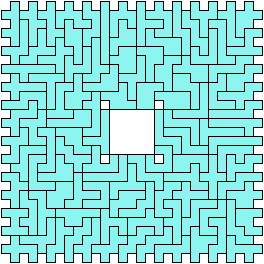
Seeing as I have an excess of spare time on my hands recently I've been attacking some constructions that I had previously written off as 'too hard' or at the very least on the boundary of what I could do without 'cheating' and using a computer solver. One of these is the following 29x29 rectangle with wrinkly crenelated edges around the outside, and a little 5x5 hole in the centre. And a couple of other little holes too because the harbour heptomino needs something to chow down on.


This wasn't the easiest thing in the world to put together. The first challenge was the outside corners. There are a very limited number of pieces that can occupy those corners, and I only discovered this a little way into the solution - too far in to just backtrack and start again, corners-first. Miraculously I hadn't used up too many of those precious corner pieces when I realised, so I was able to keep on trucking.
The whole perimeter of this was a completer pain in the arse to do. I started out with the left-hand edge, using pieces derived from the C- (or U- if you're weird) pentomino but they ran out fast and by the time I got to the final edge (the right-hand side) I was stuffing whatever pieces I could in, in the desperate hope they'd fit.

And they did. But they didn't leave a nice set of pieces remaining. And they didn't leave a nice shaped internal hole either. Still, I pressed on.

Fig. 2: Approximately what I had left to contend with after completing the perimeter.
From here I filled in the remainder of the space going around clockwise starting from about the 4 o' clock position. In fact, here's a needlessly detailed step-by-step of what I did. I usually refrain from this on the grounds that it's not very interesting, but really, is any of this very interesting?

Firstly, that question mark-shaped piece was just crying out to be put in that question mark-shaped hole, so I did that. Then there were a bunch of really hideous pieces (the other orange ones) that I just felt needed to be used up as early as possible, just so I didn't have to look at them again. Those two sort-of cross shaped bits especially. Winding up with one of those near the end of a solution when you're down to a handful of pieces is the stuff of nightmares.

Then, using up all those long S and L-shaped pieces because they're no fun either. Sadly, in order to do this we had to sacrifice that nice 2x4-with-a-notch-taken-out-of-it piece, but it was for the greater good. And now the edges of the hole in that top-right section are all relatively smooth and straight - ideal for for the very end game when you're solving with relatively squarish blocky pieces.

This is where the going started to get even tougher. Those two red pieces especially, I have a personal vendetta against now. I managed to get them all packed in there - but at what cost? So many potentially useful end-game bits used up in their prime.

Got that top-left corner squared off. And at this point we're left with not the worst hole in the world (that award would have to go to... I don't know, the ozone hole? Or the holes in the end of trombones that allows them to make their noise), but not the easiest to solve either. That two-cell-deep well at the far left was to haunt me for the next hour or so.
And the pieces I was left with to try and plug this hole? Check out this ragtag bunch of misfits:

Admittedly not the worst selection imaginable, but still... especially that one that kind of looks like a number 4 or a heavily-damaged tuning fork (kindly marked in orange for your identifying pleasure), that can suck a fat one. You'd think that piece and the 2-cell well would be a match made in heaven, but try as I might, it just was not to be...

At this stage in the game, there really is no more technique to speak of, no prioritisation of pieces or synergies between two pieces that are painful to deal with on their own but make a well-behaved 14-omino when coupled together. It's just a case of try something then if it fails tear it out and try something else. And that makes solution times vary wildly. Sometimes just through blind luck you'll stumble upon a valid solution after five minutes; other days it's hour after grueling hour trying various configurations in vain.  I guess the factor that determines how long this takes will be how many solutions to this particular endgame there are lurking in the search space as you wander randomly through it.

I got all but one piece in several times as I was doing this one. That's always the worst, that feeling of so near yet so far... And there's another weird thing that happens occasionally when finding a correct solution. It's when you get that 'eureka' moment, that "Yes! I've done it!" spark of excitement a fraction of a second before you've actually understood how the last two or three pieces are going to fit in there. I'd write it off as premature celebration if not for the fact it only ever seems to happen when I've got an actual solution on my hands - maybe I'm subconsciously spotting the solution and the rest of my mind takes that split-second to catch up? 'Tis a mystery.

Here's the eventual configuration I found. A quick consultation of some solving software tells me that there are 9 solutions to this, and that 5 of them do fit that '4'-shaped piece into the two-cell well, so goodness knows how I managed to miss 'em all.

In fact, here's all nine, since I'm being so generous with the pictures today. Mine is number 7.


And while we're on the subject of wicked tough constructions, here's another recent one that might be a contender for 'hardest construction so far', or at the very least most time-consuming:


As I've probably mentioned at some point before, octiamonds are just not a pleasant bunch of shapes to work with.
Sorry, no step-by-step account for this one. Partly because I solved this about two weeks ago so I can't remember the solution process clearly (other than that it was all over the place), and partly because I'd rather not re-live the experience. All I know is I solved the bottom edge first, and the rest followed, four hours later...

Friday, May 1, 2020

The cruel irony of all this is I'm awful at Tetris

I've been playing with a set of hexominoes a lot recently. It seems the bottom of the barrel wasn't as thoroughly scraped as I'd previously thought.
It turns out there are a family of shapes that approximate hexagons with angles of 90 and 135 degrees that are just as versatile as rectangles, if a little less pleasing to the eye (especially if you're not too fussy about them having a few holes in 'em.) These also have an added bonus: the diagonal edges make these a slightly more challenging solution than squares and rectangles.

Again, odd x odd bounding boxes seem to work best with this, because an even width or height would mean a line of symmetry bisecting the entire shape into two congruent 110-cell sub-shapes, which would mean the overall shape has balanced checkerboard parity. So with the aid of a hideous and confusing spreadsheet I knocked together, I found the following set of solvable problems:

3x73 - 9 holes
Yeah no. I think we can generally rule out the possibility of any purely 3xn constructions with hexominoes. I roughly outlined my reasoning here (but that's not a rigorous mathematical proof so it could well be wildly incorrect...)

5x54 - 3 holes
Pros: At this width solving these shapes feels not much different from solving a normal rectangle.
Cons: Solving a width 5 rectangle isn't exactly a walk in the park.


7x35 - 11 holes
At this point there's a sort of 'choose your own difficulty' option built in - with the difficulty levels being hard, harder and hardest, naturally. Two immediate options for arranging the 11 internal holes are having them as one big 11-omino, or as a line of 11 individual monominoes. The long 11-omino option creates two stretches of treacherous 3xn space which takes a bit of doing:


Whereas the individual holes introduce all manner of feisty challenges.


This one's left as an exercise for the reader. I spent a little while trying to solve it and got fairly close, but not close enough. I think I gave it like 45 minutes or so and wound up with like 6 pieces remaining a few times. But they were never nice pieces.

9x29 - 11 holes


This one was tough, although in hindsight this could be because of a complete lack of solving strategy. The obvious (looking back now) thing to do would have been to solve the ends first, then either the top half or the bottom half of the middle (if we think of the row of holes as a dividing line), trying to leave a fairly convex-looking endgame to be filled in last with the 2x2-block-y pieces. Instead I just went at it the way a nine-year old would his first all-you-can-eat buffet, and I paid for it dearly by spending maybe close to two hours (!) getting those last few bits in.
You know you've utterly stuffed it when you're down to the last five pieces and one of them is the stair-step hexomino (as it's known in Conway's Game of Life terminology).

11x25 - 5 holes
This is the start of the sweet spot, so to speak. Wide enough so that the central holes don't get in the way too much, but not so wide that there's miles of diagonal edge to contend with.


Of course, the fact that there's only 5 holes maybe makes this a little easier too. You could just as easily do this with the holes arranged vertically. Or with one bigger hole shaped like a pentomino of your choice.

13x23 - 5 holes


Can be done with the five holes the other way on. (So can the 11-height one but I didn't think of it at the time.)

I think there is a 15xn possible but it's going to have like 17 holes or something, and I think there's a point where unless you can arrange them in a particularly pleasing way it just gets silly. So I'll skip over this and go straight to...

17x21 - 3 holes and 19x21 - 9 holes
No solution images here, for the simple reason that I just plain can't be arsed. If you want them that badly, acquire a set of hexominoes and have a go at finding them yourself. More fun than looking at a picture of someone else's solution, guaranteed. Or feed them into a solver program, they'll eat these for breakfast.

And finally, 21x21 - 11 holes
This is just a rotated square at this point. And I've seen a solution for this on the internet somewhere, with the 11 holes as the straight 11-omino dead centre. As far as I can remember it was illustrating something to do with parity imbalance, and this was the example where the difference between black and white squares is exactly ±22, the maximum permissible. I assume that the restrictions that places on parity-imbalanced pieces means it's a head-bendingly difficult solution.

[EDIT: The solution I saw somewhere was here, on page 9 of Chessics, issue 28]


(The above solution was found using a computer search. Because it sounded like it might be difficult to do, and I'm always one to back down from a difficult challenge when one presents itself.)