Tuesday, December 31, 2019

Where to next?

At this point I've written pretty much everything there is to write regarding stuff like my solving process. And a lot of times when I solve something with hexominoes or heptominoes now, it isn't anything particularly interesting or challenging or worth telling the internet about - just more of the same.
So the plan for 2020 might be to sort of vary thing a little bit, still keeping it firmly to do with polyforms but not just a monthly 'Here's a bunch of pictures of heptomino constructions with not much in the way of descriptions to go with them' type posts. Which is what this place has a very real risk of becoming.

Fig. 1: Three 16x16 squares with the heptominoes.
See?

That one was actually solved with laser cutting in mind, if I ever wanted a nice new set of heptominoes, cutting this design from 3 small (180x180mm) pieces would be way more cost-effective than trying to cut them any other way. Probably.

Then a few weeks ago I solved (mostly) the one below. Instead of doing what I usually do and spreading out the set of heptominoes out all over the desk before solving manually, I did this by drawing it directly in MS Paint and crossing off the pieces from a list as I went. This has a few advantages - since I'm drawing the complete outer shape first I can guarantee I've put the centre hole in the right place. And it saves me having to redraw the solution once I've found it. And that's a fair enough trade off for not being able to backtrack nicely. And there being a risk of drawing pieces in wrong as well. For all the shortcomings of using a big ol' set of physical pieces, there's never the possibility that you'll place an n-omino with the wrong n while you're solving.

Fig. 2: Three 11x23 parallelograms. First two by hand, last one partially completed with computer search.
It's putting the last 15 or so pieces in that are the worst when you're doing this without a physical set. Backtracking and keeping track of which pieces have and haven't been used is just too much for my little mind. Especially when I'm tired and it's an evening and I've been at work all day. Which is most of the times I do things like this.

So yeah. Expect a more varied polyominoes blog in the new year hopefully.

Oh. And another thing. The future may involve octominoes a bit more...

Saturday, December 28, 2019

Octominoes: The Hall of Shame

Hoo boy, where do I start with this one?

Fig. 1:  ;~;
This is what happens when you solve without a physical set of pieces. Pieces that don't belong in the set (in this case, the two blue nonominoes) creep in undetected, and only when you're down to the last little corner do you realise that the remaining space is the wrong size. I do a quick manual check to see if the number of free squares are divisible by 8 at about this point, and in this case it wasn't so I engaged panic mode (i.e. looked for the offending pieces, found that they were nowhere near the edge of the solution, and gave up.)

This was my second crack at the same solution, a month or so later:

Fig. 2: Another 4 hours I'll never get back.
This time, the area of the final space was divisible by 8, but it wasn't the multiple of 8 I was expecting. I had 15 octominoes left to place, and an area of 14*8 = 112 unit squares. So I reckon I've used a piece twice somehow. I've looked over the solution but can't see it, so if anyone actually reads this and has a better eye than me, see if you can spot what I did wrong here.

A while after all this, I read somewhere that octominoes have parity constraints of sorts. Or at least the 363 unholey ones do. (See here, click through to 'Other octomino constructions' and it's about 2/3 the way down.) I'm still trying to get my head around this; I'm still not sure if and how it will impact constructions like this. Maybe this shape wasn't even solvable to begin with, since I put down the holey octominoes first, reducing the construction to a solution with the set of 363 unholey ones?

Sunday, December 15, 2019

Hardware Upgrade

Exciting times! Well, depending on your definition of excitement anyway. This blog sets the bar for exciting pretty damn low.

To cut a short story even shorter, I found a laser cutting place a little while ago and got a set of pentominoes and hexominoes cut from acrylic. It's one of those times it really hits me we're living in the future, the fact that I can just draw up a .svg file of whatever polyominoes I want, click a few buttons then a week or so later those exact polyominoes rock up at the house in physical form.
(Actually I was out when they attempted delivery so I had to trail right out the the sorting office, but it's still pretty impressive. That or I'm just easily impressed.) Anyways, here they are:


Just look at all that sticky protective stuff on the perspex - that's on both sides of the pieces, which took an absolute age to manually peel off each individual piece. Worth it though, they're all lovely and pretty and shiny.


Not that you can tell, mind you, thanks to the amazing fuzzy blurriness of my phone camera. I've been meaning to get a proper camera for ages now. But then again I'd been meaning to get polyominoes laser cut since about June so that might be a way off yet. I just have a habit of putting off doing things for no real reason, which isn't good.
What is good however is the way these hexominoes are when you use them. My original set were cut on a CNC routing machine, and as a result have these weird beveled edges thanks to the width of the drill. Which means that when you turn pieces over they look weird, and sometimes pieces just don't comfortably fit together, mainly interlocking pieces with C-pentomino-like indents in them. But these are all nice and precise and fit together flawlessly, it's just so satisfying to sit there building stuff with them. Oh yeah, and they're scaled to 1cm squares too, so I can use that cutting mat to assist with construction. (Not that it helps much clearly, given the amount of patterns I've cocked up due to misaligning things in the past...)

Here's the full set. Hexominoes, pentominoes, and a bunch of little monominoes and dominoes which are useful for marking out pattern boundaries and hole locations and other such things.


Of course the real goal here wasn't just to have a nice spanking new set of hexominoes. Lord no! These were just a test run really, to see what kind of quality the pieces would be and how much everything would cost, stuff like that. But now that I know this works, the plan is to get myself some octominoes made. Never mind that there's not a big enough flat surface in the house to use them on, that's besides the point. Octominoes! Picture it, all done in fluorescent clear plastic so you can see the boundaries between pieces nicely - that's the one flaw with these hexominoes, but I chose a solid colour on purpose so when I eventually make the octominoes they're visually distinct.

And try not to think about how long it'll take to manually remove the scratch-protection sticky business from all 369 octominoes. On both sides.

Oh yeah, almost forgot, here's a couple of little hexomino things, just since I've been playing with the new set quite a bit recently. Here's a better illustration of the 11-hole rectangle from the photo above, because due to a combination of lighting and piece colour you couldn't really see what's going on:


And here's a 5-cell high parallelogram that was a ball-ache to complete. In fact I used a program to place the last 8 pieces in a fit of laziness. It was getting late and I had other stuff to do.


And then I found a bunch of different pattern variations based on a 15x15 square with 15 holes. There's some quite nice challenges here, analogous to the pentominoes in an 8x8 square with 4 holes that you can place wherever. It's hexominoes though so parity constraints mean you can't just stick the holes anywhere, but it still leaves enough room for creativity. Hell, now that I can laser cut stuff I'm thinking about the possibility of making a little tray to hold a 15x15 solution, and 15 monominoes in a very different colour that can be used as a little self-contained puzzle.
Here's three example solutions for you to feast your eyes on, arranged from left to right in increasing order of fiendishness.


Sunday, December 1, 2019

More heptomino things

Recently I've been way busier than usual with non-polyform-related things. There haven't been as many evenings where I could just whip out the ol' heptominoes set, so constructions have been a little thin on the ground. Additionally, I can't help but feel I'm beginning to exhaust all the possibilities with just heptominoes (well, all the interesting possibilities anyway, I'm sure there's plenty more rectangles with holes in them possible but after the first five or so they don't make for particularly gripping blog posts.)
Anyway, to kick things off here's a squarish shape with minimal holes and maximal possible symmetry, that I'm surprised I hadn't thought of sooner:

Here's two parallelograms, using the full set of 108 split between them. Getting the holes centered here was hard, it's impossible to eyeball it and it's a bit of a pain to work out where they should be by counting. And it never looks quite right either, just due to the sloping nature of the diagonal sides. Still, far as I can tell this is correct:

For reference, the first one took about 10-15 minutes, and the second one took a bloody age because I'd foolishly forgot to use the [ shaped piece up earlier. And it doesn't play nicely with other pieces.
Things like three 11x23 or 4 10x19 parallelograms are probably possible too. Next time I've got a free evening I'll have a crack at one of them maybe.

A while ago I found a nice hexomino solution (about half-way down that page) that had a 7x9 rectangular hole in it, which could fit a set of pentominoes inside it with 3 cells to spare. Well, I went one better and found a heptomino frame that could accommodate that inside it, creating the following three-layer pattern. With the holes spaced nicely around the edge too. Forget 45° zig-zag edges - five-cell-high tubes with heptominoes are my new least favourite thing to solve.


To me right now, this just screams 'find a fourth layer with the octominoes!' I haven't checked yet if it's mathematically possible to, or at least if it's possible without introducing more holes than the 6 required for the six holey octominoes. I'll have to have a check.

Friday, November 15, 2019

3½-ominoes?

Not strictly polyominoes but close enough really. I have no idea how I first found out about this set of pieces - I always had a hunch it was the set used in Martin Watson's puzzle 'DemiTri' (which doesn't look like it's on the site any more) but that says 12 pieces. And attempts to create similar sets in Peter Esser's program by slicing tetrominoes or adding half-squares to triominoes yields 12 and 13 piece sets respectively.

Fig. 1: The set, crudely rendered in Microsoft Paint.
But this looks like a complete set to me, all the ways of putting together three squares and a triangular half-square (if there's a fifteenth one and I've missed it let me know) and it's got a total area of 14 x 3.5 = 49 unit squares, which suggests (among other things) a 7x7 square:

Fig. 2: Here's one I made earlier.
Technique for solving these is a tad unusual. Since they each have one diagonal side, if the outer perimeter of the shape you're filling has no diagonal sides than the pieces are effectively 'paired up' by joining two at the diagonal edge. This results in any shape like this being split into seven heptominoes which can be in turn split in half to give two pieces. So my technique was to first put together a couple of promising looking heptominoes (i.e. ones containing 2x2 or 2x3 rectangles) then trying to fit those together. I used this method to cobble together the shapes below.

Fig 3. 10x5 with a bite taken out of it.
Fig. 4: These. Which can be put together to make the shape in Fig. 3.
Fig. 5: More shapes!
...and this nightmare shape that I found with a solver because there's no way I'd have the patience to do it by hand.
Sadly, these seem to be more limited with what you can do with them compared to, say, pentominoes or hexiamonds, both of which have a similar number of pieces (that, or I'm just really uncreative. I have a hunch it may be the latter.)
And there's also a scary bonus thought - this set of pieces is just one in a family. There's scope for doing things with the sets of pieces which are four squares and a triangle*, or two squares and two triangles, and so on, and at that point we're approaching just regular sets of polyaboloes or polytans or whatever people generally call them.
But that's going to have to be a post for another time.

---

* If I counted correctly there's an odd number of these which might further limit what can be done with them.

Wednesday, November 13, 2019

20x20 Diagonal Square with Heptominoes

It turns out the heptominoes can do four congruent right-angled triangles, each with a single-square hole at the right angle:
Fig. 1: Four 19x19 triangles
I solved the first three quadrants of this by hand (the red, blue and green ones) then utterly despaired at the thought of having to do the fourth one. As a result of using my normal solving technique, I'd found myself left with a selection of mostly quite blocky, squarish pieces then realised that these pieces don't generally lend themselves well to building wiggly edges. For finishing off relatively square shapes like the last corner of a rectangle or something they're fine, but for this I wasn't sure. So I wrote it off as a bad job.
Then a few days later, I drew the pieces into FlatPoly2 just for the sheer hell of it and it found a solution in about a minute.

These four triangles can then be put together in various different ways, including this 19x19 (Edit: it's 20x20, I can't count) diagonal square:
Fig. 2: The holes don't quite match the symmetry of the outer perimeter but whatever.

Saturday, November 2, 2019

'Measure twice, construct once'

Building something only to discover that I've somehow put the central holes in the wrong place seems to be a common theme for me. I need to implement some 'measure twice, construct once' philosophy maybe.
A short while after I wrote that big long post about combining pentominoes and hexominoes into one set, I thought about how just possible it would be to knock out a 4xn rectangle with those pieces. I mean, each piece would physically fit into a 4 cell high rectangle, and if it's possible to squeeze all 1- to 7-ominoes into a 5x211* then this could well be possible too.

The whole 4-cell-high thing made it tricky but not as big a challenge as I had initially suspected it was going to be. After 45 minutes with my hexomino set (and a shoddy set of pentominoes cut out of graph paper to supplement them) I found the pattern below. With the two holes off-centre by one...

Fig. 1a: Side note, I'm not mad on this arrangement of holes but it's the most symmetrical one I can think of for two holes in an even x even rectangle.
Thankfully, as I was sketching down this solution, I notices it wasn't as bad as I'd feared - there was a central section (marked in light gray above) which could be flipped over and had the effect of transposing the two dots over by one cell - into the middle!

Fig. 1b: The finished construction.

Of course, there's rarely a nice quick fix like that, as I discovered with a heptomino construction from a few weeks ago. The harbour heptomino and its little central hole must have been accidentally knocked during the solve process and I hadn't realised. Only upon drawing the solution down onto graph paper did I notice it was slightly off. There was no quick little rearrangement of pieces that would fix it this time. I just had to solve the entire thing again in a few days' time.

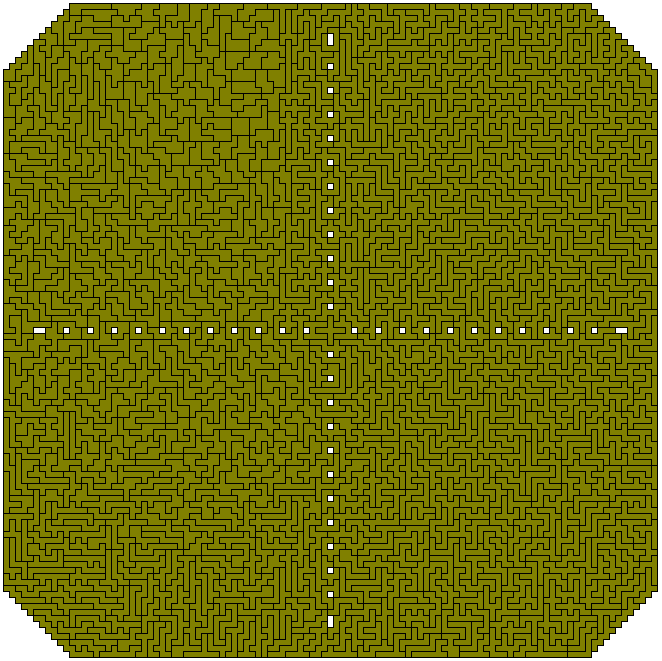
Fig. 2: The heptominoes in an octagon with central hole. Coloured by how far each heptomino is from the edge of the construction, just to see how it would look really.
Notice the way the diagonally-symmetric pieces are all grouped nicely along a diagonal running from near the south-west edge up through the centre. Basically, I noticed in one of David Bird's nonomino constructions (typically, the one I can't find on the internet anywhere to link to; it's in S.W. Golomb's 'Polyominoes', page 116) that all (or at least a good chunk) of the rotationally symmetric pieces were grouped together in the central section surrounded by holes**. And somehow I'd never noticed that before. I just like the idea of little things like that, 'hidden' in plain sight within the construction that reveal themselves on closer inspection. (Another one I like is in a heptomino construction by Nick Maeder, third one from the bottom on this page, which has the crucifix-shaped heptomino in the centre of a triplicated version of itself, all positioned centrally within the pattern.)

---

* I've seen this done but can't find it anywhere on the internet, but can't find in anywhere or I'd link it. Maybe it was in the middle of an Internet Archive binge of polyomino-related sites that are no longer up.

** Actually, there's something similar going on in this nonomino construction, also by David Bird. A lot of symmetrical pieces are grouped around the line of holes running upwards from the middle.