Sunday, November 29, 2020

Little stopgap post while I think of something decent to write about

It's been a little while since I last posted anything on here. Here's a nice 4-way symmetrical heptomino construction, does that make it better?

Fig. 1: Those corners are surprisingly restricting of which heptominoes can make them.


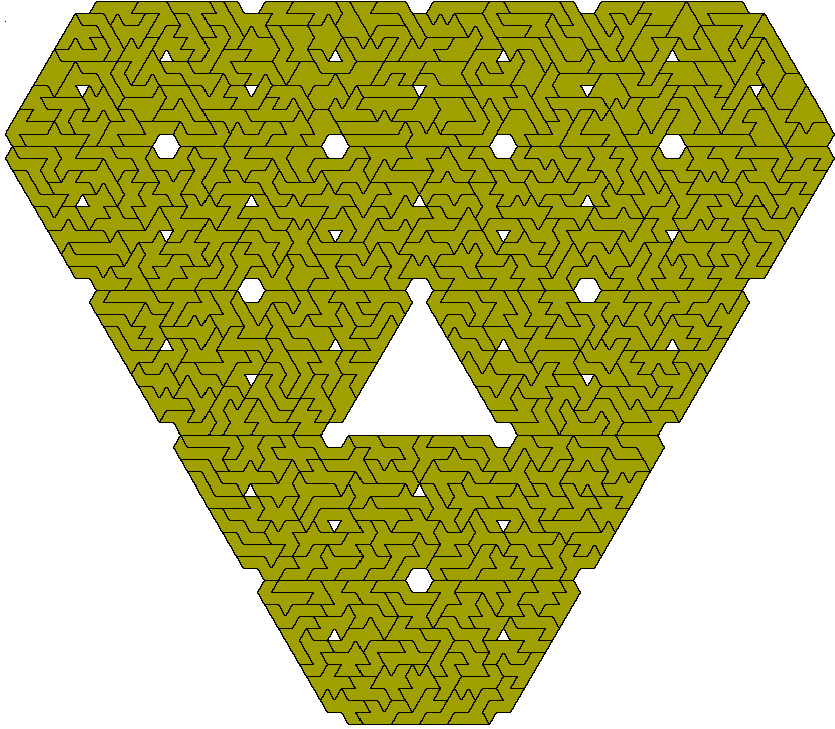
In the past I used to crack open the box of polyform stuff in evenings as a way of relaxing and calming down, but recently I stumbled upon this monstrosity which seems to have the opposite effect on me:

Fig. 2: Eww gross.

Called the 'sawblade' in my little notebook where I sketch out possible constructable shapes, and although its just a pure hexomino puzzle it's way harder than it has any right to be. I found the above sort of near-miss early on, which fit all the pieces but had an asymmetrical clump for a central hole which just looks wrong. I mean, even the 'proper' solution has a 2-fold symmetrical hole in the middle of an otherwise 4-fold construction so it's never going to be perfect, but this was just too imperfect to live with.

Fig. 3: Better (marginally...)

It took a further three days of trying on and off, just whenever I had half an hour or so spare until I finally stumbled on a solution that had the central hole looking some way presentable. The real nightmare pieces in solving this were the long straight bits, the I-hexomino and the various pieces with a 5xn bounding box. And the big L-shape piece. Usually these can be sat against the flat walls of rectangular constructions but not in this case... Learning to use these up early on seemed to be the key to cracking this one.

I'm toying with the idea of laser-cutting a fresh new set of hexominoes (again...) this time using transparent acrylic so I can see the boundaries between pieces. It's tempting to make a tray for them shaped like the above pattern, especially since it's approximately square so the entire tray would be relatively compact. I could maybe have the central heptomino 'hole' in a contrasting colour too. The only drawback of all this would be that every time I wanted to tidy the pieces away into the tray I'd have to go through the ordeal of solving it.


 29th? Yesss! didn't miss a month!

Sunday, October 11, 2020

More Octominoes

Here's a few more (okay, two) octomino constructions from over the past few weeks. Mainly boring shapes like rectangles, just because I'm limited by the size of the desk in my room. A big diamond with diagonal edges would be awesome but it's just not going to fit on the available working space, in fact this one with height 57 really pushes the limit of what I can do, it was practically overhanging the edge of the desk:

Fig. 1: A 57x63 frame that fits the 23x33 heptomino rectangle perfectly inside it.

An odd thing with n-ominoes is this - as n increases, not only does the number of n-ominoes with a particular feature increase, but the proportion of all n-ominoes with that feature increases too. Take polyominoes with holes for instance. With heptominoes there's one, giving a proportion of 1/108 = 0.93%. With octominoes it jumps to 6/369 = 1.63%. And this trend seems to keep going, as shown below.

Counts for the really big polyominoes taken from here. Sorry it's an image and not a copy and paste-able format, blogger hates tables for some reason.

My gut feeling is that this keeps going, approaching 100% but never quite getting there, instead tapering off in a big s-shaped curve.

Here's a graph that has everything wrong with it. Default OpenOffice design, tidied up in MSPaint, uses percentages which I assume isn't good form for actual scientific purposes... I may as well have gone the whole hog and done the captions using WordArt.

The same trend seems to hold true for other features too, such as polyominoes containing a 2x2 block inside them somewhere as a subset of their squares, or pieces with a two unit deep well (like the pi heptomino.) I guess it could be in part down to the fact that as n increases there's more scope for a given piece to exhibit several of these features at the same time, e.g. have an internal hole as well as a 2x2 sub-section. Maybe? This feels like the kind of territory that would need approaching from a rigorous mathematical angle, but I have no idea how to do that so the best you're going to get is me guessing wildly based on a hunch I got from spending too long playing with glorified jigsaw puzzles.

Here's a 29x102 rectangle with the octominoes. David Bird beat me to the punch by several decades but I'm still going to share it here anyway, dammit.

Ooh, and we get a final bonus guest solution this time too... I had shared an older polyomino solution (the one with concentric layers of 5- through 8-ominoes) to the Puzzle Fun facebook group, mentioning that there was a possibility for a 121x129 layer of enneominoes to surround the entire construction. Sadly, there was no arrangement of holes that would preserve the symmetry of the hole distributions in the inner layers, but I settled on something close enough and Patrick Hamlyn found the following solution for it:

(Click for full-size.)

Interesting to note are the pieces his search program saved for last - the ones just below the bottom-left corner of the octominoes section. There's a lot of the kind of pieces I'd expect, blocky, rectangular pieces, but also a lot of long thin bits with a completely smooth edge on one side. I'd never considered holding onto these pieces that late in a solution, but clearly it gets results so it's maybe something worth me experimenting with while solving by hand.

And yeah, if anyone fancies wrapping a set of dekominoes around that, that would be grand.

Friday, September 18, 2020

A Fun Little Challenge with Pentominoes and Hexominoes

 I've probably seen this done somewhere else but I can't think where or else I'd drop a link in and let them explain it better than I can. Basically, the idea is to create a rectangle (or another shape, I won't judge) out of the pentominoes and hexominoes together - 270 units total so you've got a few choices here. But, there are a few restrictions you can place on the positioning of the pentominoes.

For the easiest option, forbid the pentominoes from touching each other (either by sharing an edge or touching point-to-point.) Or if you want to ramp up the challenge a bit, prohibit the pentominoes from touching the edge of the rectangle too. This is essentially a hexomino construction with 12 pentomino-shaped holes in it, if you want to think about it that way. Below are pictures for the 15x18 and 10x27 cases, but there are several other aspect ratios possible, the thinner the rectangles become the harder I imagine it'll be to keep the pentominoes away from one another.

Fig. 1: The 15x18 solution in a colour scheme that would have Ikea's lawyers frothing at the mouth

Fig. 2: A 10x27 solution

Monday, September 14, 2020

Enneiamonds

You know that feeling you get the instant it hits you you've bitten off more than you can chew? I may have got just a little bit of that feeling when I first tipped out the set of enneiamonds onto my desk:

The actual pieces themselves are smaller than I'd anticipated, due to me scaling down the SVG files I'd made then forgetting before I sent them off to be cut out. But they still work properly, now with the added bonus that they don't hog my entire tabletop when I'm mid-solution.

They're a lot like heptominoes, if you were to take everything I hate about heptominoes and turn it up to 11. There's a similar number of pieces (160 vs. 108), including one with a hole, but their complexity seems to be upped just a tiny little bit - I think it could be the mixture of 60° and 120° angles which pushes the difficulty a step beyond. And there's a very small selection of easy looking shapes (see the top left of the photo where I've tried to pick them out). It's less than the amount of nice heptominoes, but enough that it promises an endgame that feels a little less like the random trial-and-error ordeal of heptiamonds.

The total area of the enneiamonds is 1440 triangles, which is 4 less than 38²=1444 which means a triangle with side length 38 and four holes is (in theory) possible. A hole at each corner and a fourth hole dead centre; I decided not to think too hard about possible parity constraints and jumped right in.

There's a 'difficult zone' with polyiamonds. For small sets (hexiamonds and below) there are fewer pieces so usually you can solve puzzles with them fairly quickly. And for much larger sets the amount and variety of pieces is so great that no matter what kind of jagged mess you've got yourself into mid-solution, there's always a piece (maybe several) which will fit perfectly. And there's a good handful of the aforementioned chunky pieces that make the very end easier. Between these two extremes lies the heptiamonds and octiamonds - as mentioned in the previous post these seem unreasonably hard. And I was fearing that the enneiamonds would be the same.

I'm tempted to say that the enneiamonds fall just beyond the far side of the 'difficult zone'. But I can't really since I didn't actually finish solving the triangle manually. I got as far as the last 8 or so pieces then threw in the towel after half an hour or so of trying various possibilities. I resorted to inputting the remainder into a solver (Peter Esser's trisolve) and backtracking one piece at a time until I found a solvable state. From there I could have returned to the puzzle with the knowledge that it was at least doable but I was pushed for time, and I knew the sense of achievement would no longer be there.

The colours look nice, but they still don't allow you to see the borders between pieces very well.

Centering the hole in the middle was tricky too. With polyominoes it's easier; the grid on the green cutting mat is to the same scale as the pieces so I can just stick a monomino wherever the holes are going to be. But with this it was tougher - solve up to the rough place where the holey piece is going to go, then count rows in all three directions and shift the piece around until they're equal.

Had I not been on my lunch break (and conscious of how long I was spending playing around with these) there's a chance - yeah, a low one admittedly - that I could have solved the entire thing by hand. But for now, it's a respectable enough first attempt at solving something with this set. And I learnt some valuable lessons: mainly that some of the pieces I was holding onto weren't as cooperative as I'd previously hoped. There were a few long skinny pieces with fairly smooth edges that I'd kept back and these turned out to be a total ball-ache and part of the reason I gave up when I did.

Here it is, drawn out so you can see the individual pieces:

I tried drawing it in Inkscape instead of MS Paint this time, which was much faster but caused all these little variations in line thickness. Some day I'm going to have to learn how to properly use image editing software.

Monday, September 7, 2020

Polyiamonds: A Spotter's Guide

Introduction

Polyiamonds are the shapes made by connecting equilateral triangles edge-to-edge. What sort of polyiamond you've got depends on how many triangles it contains. If it's just the one triangle, you've got what could be called a moniamond or mono-iamond, but is probably better off just being called an equilateral triangle, for everyone's sake. Two equilateral triangles stuck edge to edge creates a rhombus, or diamond if we're using the 'iamond suffix.[1]

Now stick a third triangle onto one of the sides of this diamond. This creates the legendary triamond, which is just half of a regular hexagon. Now when it comes to adding a fourth triangle, things get interesting. Interesting enough to warrant a diagram.

Fig. 1: Can't beat a bit of MS Paint, eh?

There are three unique ways of attaching that fourth triangle, creating the three tetriamonds. There's not as much variation here as there is with the square-analogues, the tetrominoes. In fact, as you increase the number of triangles the total number of polyiamonds increases, but at a much slower rate than the polyominoes.

Fig. 2: Numbers of free n-ominoes, n-iamonds and n-hexes for n=1, ..., 10. Polyhexes grow stupid fast, but that's a story for another time.

This of course is all assuming we're talking about 'free' polyiamonds anyway. That's free as in they can be rotated and flipped over, not free as in there's a bunch of unlockable shapes as in-game purchases or anything. If we allow the pieces to be rotated but not turned over, we get the sets of 'one-sided' polyiamonds, and if we disallow rotation too we get the 'fixed' polyiamonds. If we disallow rotation but allow pieces to be flipped over it would just be weird.

The 3 free, 4 one-sided and 14 fixed tetriamonds.

Pentiamonds

There are four free pentiamonds. And that's just not a big enough set to do a great deal with. But by considering reflections as distinct (i.e. the one-sided pentiamonds) we get a set of six which cover a total area of 30 triangles. This allows the set to be packed into a selection of little shapes, including a 3x5 parallelogram and these wobbly approximations of rectangles. And a dumpy not-quite-regular hexagon.


My recommendation at this point is to hack a set of these out of the back of a cereal box or something, they don't have to be exact as long as you can tell which piece is which, and have a crack at finding alternate solutions for the above shapes, or trying to find your own. It's also the kind of thing that could keep a child (or simple-minded adult, I raise my hand sheepishly) occupied for a while... Whole minutes of action-packed fun.

Hexiamonds


Now we're getting to the good stuff. Grab one of your pentiamonds from before, slap another triangle on there and you've got yourself a hexiamond. Keep doing it and eventually you'll wind up with the full set of 12 different shapes, each more spiky and irregular than the last. Twelve - just like the pentominoes. And if you're familiar with the pentominoes (and let's face it, if you aren't what are you doing on a site called Polyominoes The Blog anyway?) You'll know that you can do an awful lot with those twelve pieces. So this beckons the question, are the hexaimonds as versatile, as co-operative, as fun as their square siblings?
Well, the total area the hexiamonds cover is 6x12 = 72 unit triangles, which is promising. 72 divides up in various ways which suggests a selection of parallelograms at the very least - 2x18, 3x12, 4x9 and 6x6.

Fun fact: centre-aligned parallelograms always look off-centred. Though to be honest I didn't even try in this instance. Just slapped them into Paint and thought 'good enough'.

2x12 doesn't go. Too skinny. 3x12 doesn't either although you can get fairly close - real close in fact, 11 pieces - but the last piece just doesn't fit.

Close, but no cigar. (If the piece left over looked a bit like a cigar then that would have been way cooler.)

4x9 and 6x6 though, these are most definitely doable. There are 74 and 156 ways of solving these respectively (not counting rotations and reflections of the same solution) but they are deceptively tricky. That cereal box you cut your set of one-sided pentiamonds out of? Go find it, dig it out of the bin if necessary, turn it over and make a set of these pieces too. Yeah, you might have to turn the pieces over to find solutions with them and one of them might have 'RN FLAKES' or something written on one side. Too bad.
Alternatively, the board game 'Blokus Trigon' has pieces which are the stes of 1 through 6-iamonds. So if you have that you could use those. You even get a nice little board that allows the pieces to click in place when you're solving. This is what I did until I discovered the wide world of laser cutting (and the wide world of having the money to afford to get stuff custom laser cut.)

Any excuse to show off this set I made, complete with a nice little tray to hold them.

And if you get sick of parallelograms, there's no shortage of other shapes to solve too. There's the above four-row-high stretched hexagon for starters (purposely shown half-solved to entice readers to try and finish it themselves) and loads more - as long as its total area is 72 triangles and it's not too weird you're good to go.

Folks more artistic than me will be able to find all manner of solutions, I just tend to go for the obvious geometric shapes even though the symmetry of the base triangle lends itself well to snowflake-like sixfold symmetry. Think of them like a more frustrating version of Tangrams.


Heptiamonds

A deluxe wooden set of heptiamonds ('Deluxe' even though because wood was cheaper than acrylic...)

There are 24 heptiamonds (from here on in we're just going to concentrate on the 'free' ones) and at this point things get a little bit tougher. The pieces are just that little bit wigglier around the edges and that makes putting them together all the more frustrating. Various parallelograms can be made (see the image above), as well as a triangle with edge length 13 and one little triangular hole in the very centre. There's a bunch of other solution shape ideas over at the Polyform Puzzler site too, if looking at heptiamond solutions is your sort of thing.

One of the few shapes I've actually managed to solve by hand with the heptiamonds.

One of the (many) things that makes this set so tricky to solve with is the fact that there's relatively few pieces that fit nicely in a 60° corner. And when you're making a shape with triangles as a base unit, there's usually a few 60° angles knocking about.
I've noticed that when I solve by hand with these I tend to want to keep the longer thinner smoother pieces for the end. Whether that's any help whatsoever is up for debate, mind you. In fact that might explain why I'm so bad at solving these.

Another handy tip of course is just to get some polyiamond solving software going (Peter Esser's trisolve is the one that immediately springs to mind) - these make mincemeat of nearly every outline shape you can throw at it. Mincemeat in the good way.

Octiamonds


Now we're reaching the serious business. There are 66 of them which gives a total area of 528 triangles. And at this point the most popular technique for large polyomino constructions can be applied. That is, the age-old art of saving the more chunky blocky straight-edged pieces for the end. There's not a lot of octiamonds that fit this description but there's a few; enough to make the task of solving by hand a little less daunting than it first seems.

These guys. These absolute legends.

Sets of octiamonds are available from Kadon Enterprises. It's where I got mine, and it can be where you get yours if you're that way inclined. If not, lots of cereal boxes. You know the drill.

Enneiamonds

I don't know why the 'non-' prefix wasn't good enough for this lot but clearly it isn't. Just try googling 'noniamonds' and marvel at the complete lack of results that show up. 'Enneiamonds' on the other hand turns up a few sites (maybe even this blog if it gets popular!) with constructions from polyformists (is that a word?) far more dedicated than I.

An interesting thing happens when you reach the enneiamonds too. It's this:

Nine triangles can be made to completely surround another triangle, allowing for the fabled holey enneiamond to exist. Not quite as infamous as its distant relative, the harbour heptomino, but getting there. This makes it a little harder to fill shapes but it can be worked around, usually by introducing a few more holes and placing them symmetrically throughout the construction.

I've got a set of enneiamonds, laser cut out of four colours of acrylic in a way that makes them look very like primary school teaching aids, but as of yet I haven't finished any constructions with them. Peeling the protective sticky material off both sides of each piece was an ordeal enough.

Deciamonds or Dekiamonds, I'm not sure 

There are 448 of these, 4 of which have holes in them. Nevertheless, some brave and intrepid individuals have made things with the full set. Check out this over the the Poly Pages by Patrick Hamlyn. And this page which has a solution by John Greening, using a combination of several sets, all one inside the other like Russian dolls or something.

The 6- through 10-iamonds, found by John Greening (more information at the above Kadon Enterprises link.) I drew this up based on the photo on that page, but the photo itself is unclear in some places so I may have made mistakes.

Beyond these though, you're pretty much stepping into the unknown, venturing into unexplored territory.
Or if it's not unknown, there's certainly not enough pretty pictures of it up on the internet.

---


[1] FUN FACT: This isn't the etymology of the word diamond. The word 'diamond' came first and the suffix '-iamond' was back-formed from it at a later date.

Sunday, September 6, 2020

Little mini post: 4x53 with Hexominoes, Revisited

 Yonks ago I wrote a post about 4xn constructions with the hexominoes, which ended with suggesting a 4x53 with symmetrical placement of holes should be possible. Well, I found one:

Amazingly, the entire solution took all of three minutes by hand. I must have just been insanely lucky and hit on a solution on practically the first try, because I was prepared for this to take quite a while.

I guess they're not technically 'holes' when they're on the very edge of the construction but it looks nice so I don't mind really. And for an additional bonus, it's three-colourable and has no 4-way crossroads where four pieces meet at a point. That wasn't even my intention while solving it, it's just how it turned out. Rrrresult!

Monday, August 24, 2020

Octomino Ring

A 57x57 square with a 17x17 square taken out of the middle leaves a nice square doughnut with a convenient area of 2960. This is the perfect size for all the octominoes as well as eight 1x1 holes sprinkled around for good measure.

A 15x15 hexomino pattern would have fit nicely into that central hole; I wish I'd thought of that before I'd finished drawing up the image because it'd probably look nice, but I can't be bothered to change it now.

I also found a four-colouring for it too, which took a little while and a little bit of trial and error. No two pieces sharing an edge are the same colour, and when four pieces meet at a point none are the same colour there either. (At least, I hope so. There's a chance I've slipped up somewhere and missed it.)

Full solve time must have been close to six hours, with the repeated backtracking phase of putting the last 15 or 20 pieces in taking unreasonably long for whatever reason. About two hours on the 22nd, and another half hour on the 23rd until I got that little 'eureka' moment and the last few bits went in perfectly.

 Edit:

I found a middle bit for it anyway - the 289 square central hole fits the pentominoes and hexominoes with 19 squares to spare, which doesn't allow for any particularly nice configurations. The picture below is as good as I could get; sadly it doesn't preserve the overall symmetry of the octominoes' outer shape.